

Belief is a strange quality and everybody possesses it. We believe in so many things – ourselves (hopefully?), family, friends, talented people, and so on. One question troubling me was: What is the consequence of belief?
I backtracked and thought about the source of belief inside us – the mind. It controls everything, and the rest of the body is just a toolkit for the great magician that it is. There is an ambiguity here that needs to be solved. Are mind and brain different things? Usually, we consider that the mind has feelings, while the brain is the physical entity holding everything together and making those electrical connections physically possible. The mind is separate but inseparable from the brain. A cognitive neuroscientist, Caroline Leaf, puts it very eloquently – “The mind uses the brain, and the brain responds to the mind. The mind also changes the brain. People choose their actions—their brains do not force them to do anything. Yes, there would be no conscious experience without the brain, but experience cannot be reduced to the brain’s actions.” But at the same time, the mind, being a collection of memories, thoughts, beliefs, etc., is driven by the brain based on experiences. So, does the mind control the brain or does the brain control the mind?
Even the neuroscientists seem to be divided on this question and research is still underway to provide a definitive answer. Although, one thing is pretty clear that mind is the aliveness that gives energy to the brain and the body to function. It is basically us, without which the brain and the body are useless. This brings us back to the point of trying to untangle consciousness, which is the sole factor for “aliveness”. The mind or consciousness is not confined to the brain. While the brain is made of the perishable elements of nature, the mind is subtle and is the energy residing inside us that runs us. The direct evidence for this comes from some research that even plants are considered to have a “mind” of their own even though they don’t have a brain; people just didn’t look in the right place. Over the past centuries, notable figures have discussed the deep intelligence of plants, and recent research suggests that they possess highly developed neural systems, making them conscious and intelligent beings. Some researchers argue against “brain chauvinism,” claiming that intelligence is a characteristic of all self-organized systems, including plants. Plants can perform complex tasks like mathematical computations and future planning based on current conditions. The new view sees plants as dynamic and sensitive organisms, actively competing for limited resources, and capable of sophisticated communication, recognition of self, and perception of pain. They are considered conscious, information-processing beings with intricate behaviours. So, the mind is the nature of life in any organism.
(More on plant consciousness here- A Mind Without A Brain: The Science Of Plant Intelligence Takes Root)
For today’s discussion, we can conclude that the mind is the source of belief. But given the variability a mind can have, beliefs can also change over time and experiences. One may believe in, say, the Earth being flat, while another may believe in Earth being spherical. They may spend their whole lives fighting over this and at the end of their lifetimes, they would pass away without conclusion. However, during all this disagreement, the Earth exists the way it does and neither of their beliefs can change the way the Earth looks. One may or may not believe in the Sun becoming a red giant and engulfing Earth and people may keep fighting over it. Irrespective of who turns out to be right, everyone is going to die as a result of the Earth being engulfed by the Sun or by some other factor.
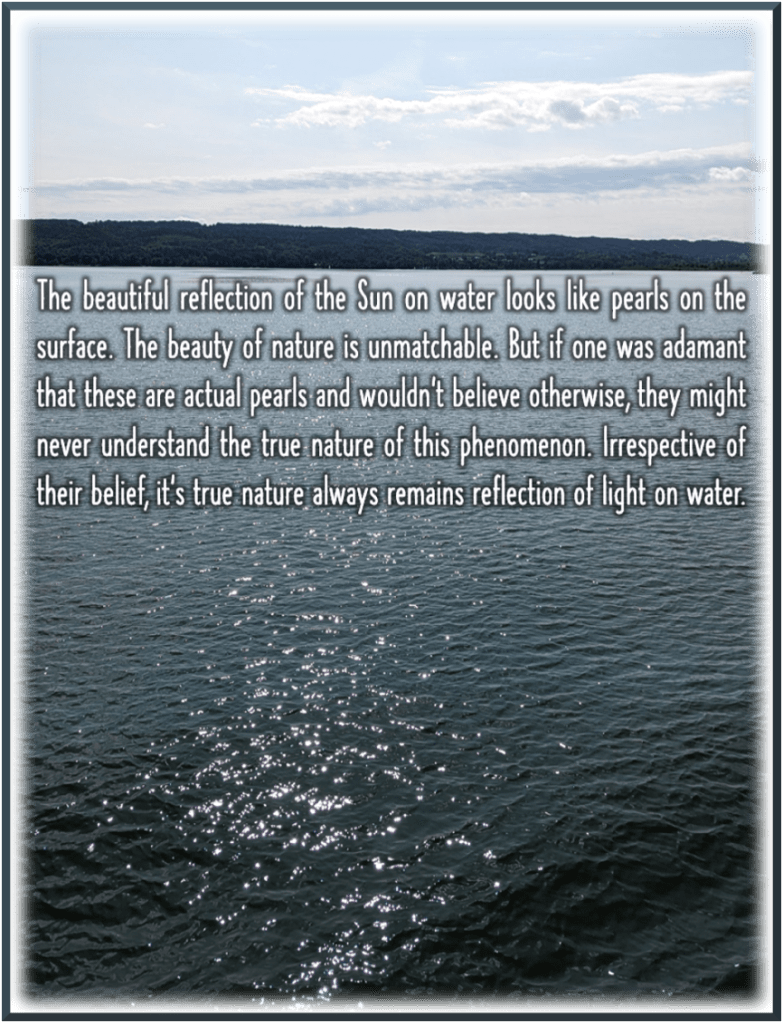
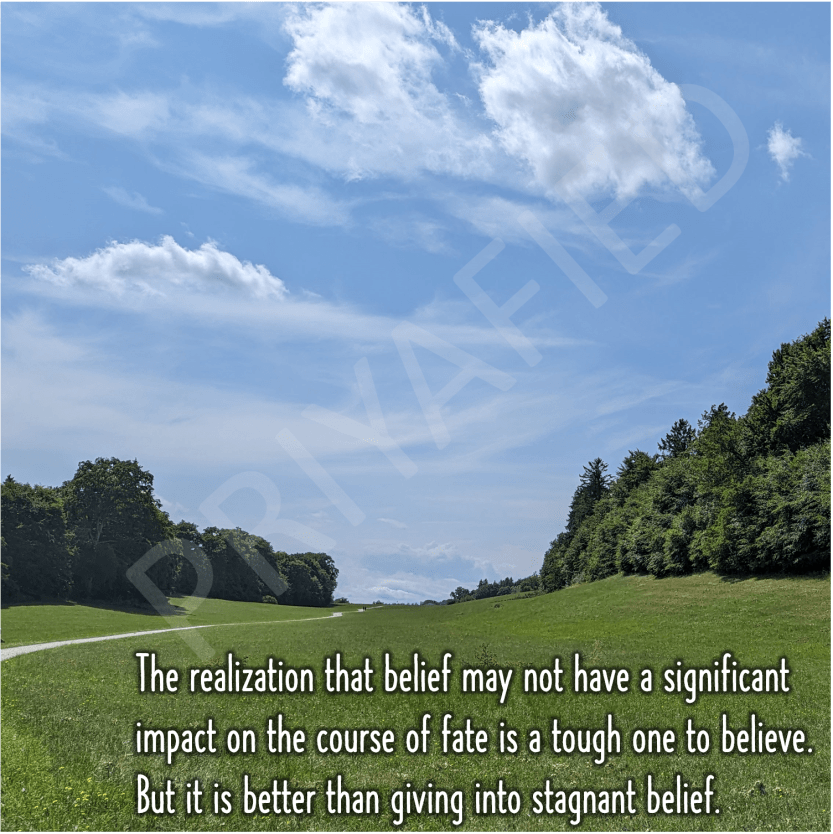
So, beliefs are meaningless on a larger scale of things because the universe is still going to do what has to be done precisely when those things have to happen. In short, our beliefs are inconsequential to fate. The moment I realized this, my life took a turn for the better. I could now think about my connection with the universe in terms of understanding it without having any anxiety over whether or not anybody believed in my belief. I am not the protector of the universe; the universe is its own protector and progressor. If my path of learning helps anybody, I consider this a bonus because knowledge is the only thing I can abundantly distribute without losing any of it myself. Beyond this, I can relax and let the universe take care of progressing itself, while I live a life that affects it as least as possible. This involves taking care of nature, not wasting resources, and respecting everything that is sustaining life. This applies not just to the Earth, but also to:
- the Sun, which is the source of the possibility of life
- the planets in our solar system, eg. the larger ones like Jupiter for changing the path of or eating up asteroids that could have been catastrophic for the Earth
- the Earth being in a Galactic Habitable Zone, i.e. a position in the galaxy protected from the harshest radiation and gravitational disturbances
In addition to taking care of my actions, duties, and responsibilities, if I make efforts into understanding the science of existence, I believe I am doing enough. And this is a belief that I would like to have as the foundation of my existence.
Critics might contend that beliefs play a significant role in shaping human behaviour, culture, and society. Beliefs can be powerful motivators, influencing actions and decisions on personal and societal levels. They may argue that while beliefs may not directly alter the fundamental nature of the universe, they are crucial in shaping human experiences and interactions. But while shaping human experiences, humans often forget to take nature into consideration. This leads to beliefs taking precedence over natural understanding. For example, people believe that if they didn’t do anything wrong, nothing wrong would happen to them. However, there are highs and lows in everyone’s lives and people end up blaming someone or something for their loss or failure, thereby, placing their belief over the natural progression of events. While beliefs can be powerful motivators, their fixation can blind us to the complexities of nature’s inherent progression.
It may be helpful to believe in learning and growth, rather than giving into belief as the ultimate goal. Point to ponder?
Discover more from Priyafied
Subscribe to get the latest posts sent to your email.

 Priyafied
Well said 💯 👏👏
LikeLiked by 1 person
😊😊
LikeLike