


Cover image credits: Askeuhd, CC BY-SA 4.0 https://creativecommons.org/licenses/by-sa/4.0, via Wikimedia Commons
There is a lot happening in our universe at all times. It is an alive system in itself. However lately, there have been some developments that have thrown scientists a little off-course from their predictions. Certain events are happening in the universe having little to no existing explanation, but their results can have a direct and huge impact on life on Earth. It is not everyday news when we receive signals from aliens, realizing we may be “aliens” ourselves, our planet starts spinning faster all of a sudden, Neptune starts changing its behavior mid-season, or the entire universe suddenly speeds up just when we thought it is going to contract back into a singularity, and more. Do we really know our universe? We are looking at some groundbreaking revelations of recent times.
How big is outer space for real?
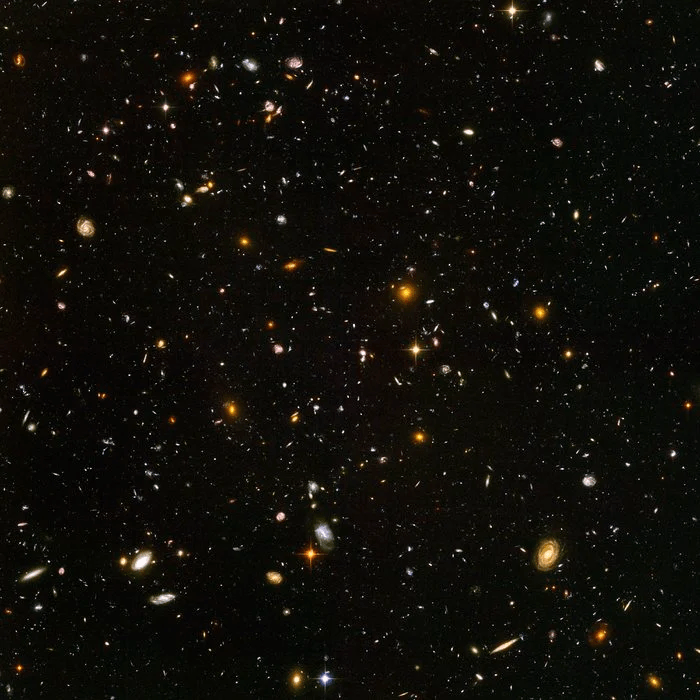
I feel that the problem with building relatability to space comes from the fact that most people are not able to visualize how big outer space is in reality. We say that the moon is 1.3 light seconds away from the Earth, or that the Sun is 8 light minutes away. But what does this mean in reality? My office is 1 kilometer or 0.6 miles far from my home. You get the distance. But do you understand the distance when I say the Sun is 8 light minutes away? In this article, you will get to see space with your own eyes.
If you haven’t read the article yet, read it here: How big is outer space for real?
If you want to see more such videos and images, let me know in the comments what you would like to see, and I will post them on my social media handles.
Signals from aliens?
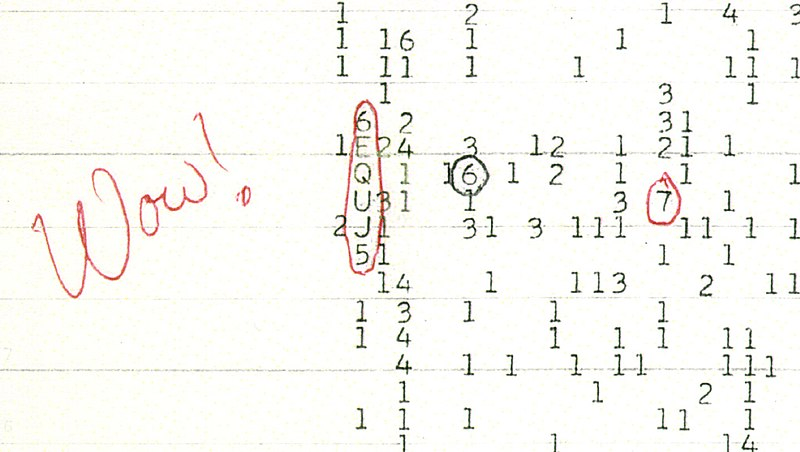
Did the fantasy from movies suddenly come to life? Are we contacted by aliens? These are questions faced by astronomers when they received a strange signal from space. This was not a signal from known natural occurrences in the universe like star-forming or exploding, collisions, etc. This was different. We received a signal from outer space which appears to have come from the constellation of Sagittarius during a SETI search at the Ohio State University’s Big Ear telescope. The scientists call it the Wow! signal because astronomer Jerry Ehman scribbled Wow! next to it on the page. Although scientists and astronomers think that it is highly likely that this signal was received from some kind of natural event and not aliens, the possibility of this being an alien signal is not null. When we have sent out signals to other galaxies, it was always a one-time broadcast (For example, the Arecibo message that was sent towards the star cluster M13 in 1974). So, the Wow! signal could have been such an attempt by an alien civilization. Astronomers have since identified a Sun-like star in that direction. Are there aliens trying to contact us?
What do aliens look like? Are we the actual aliens on Earth?
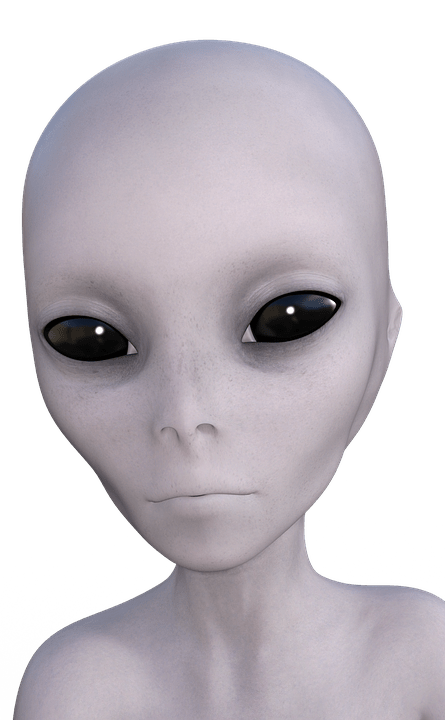
Everyone has wondered at least once in their life about aliens on other planets, especially Mars since it is our closest planetary neighbor. The curiosity has peaked so much in the last few years that we have pinned so many hopes on the car-sized Mars rover, Curiosity, which recently completed a decade on the red planet. And these hopes are not a fluke. For the first time in history, a rover has performed newly devised tests to find life on the red planet. Although those results were underwhelming, the method was a success. The search for alien life is still on, and we hope to find some useful results from these expeditions.
But what would life look like on Mars if we found it? Would Martians be civilized humanoids, some superior, highly intelligent beings, animals having human-like attributes, or something new entirely? The problem with humans is that even the search for alien life-form is being done keeping in mind the conditions feasible for humans, or other species of creatures found on the Earth. We may be the only life form we know, but it doesn’t have to mean we are the only life possible in the universe. And why just Mars?
Life could be present anywhere in this solar system, in this galaxy, in the part of the universe we exist, or in other universes (multiverse?). Life as we know is present on Earth. Is it possible that we are the actual aliens? Did lifeform come here from somewhere else? New findings show that yes, it may be true. We must know that DNA is made up of building blocks or molecules called nucleobases or bases. Our DNA is made up of four primary bases – Adenine, Cytosine, Guanine, Thymine or A, C, G, and T in short. These combine in pairs and are stacked together in different ways forming the whole DNA. Till now, astronomers had discovered A and G in meteorites that crashed into the Earth. But recently, C and T were also found in meteorites and asteroids. While it is unclear whether the formation of A, C, G, and T happened in asteroids or they are merely carriers of these nucleobases, it looks as if life did not originate completely on this planet. It was a result of contributions from other places in the universe. This opens a lot of doors for alien lifeform search.
The universe is such a vast place that if there indeed was intelligent alien life beyond Earth, we would have been visited by them given the fact that our galaxy and solar system are fairly new compared to the universe. But we haven’t yet had one such provable experience. There could be many reasons for this. Some major ones include – physical, engineering, biological, etc. difficulties making space travel not feasible, aliens deciding to skip the Earth, the advanced civilizations may be fairly new and haven’t reached us yet, or, aliens did visit us in the past but we never observed them. This is the Fermi Paradox.
Earth is spinning faster!

The Earth is supposed to be spinning at a rate of more or less 24 hours. But recently, the Earth broke its own record by spinning a whole 1.59 milliseconds faster than 24 hours. Scientists are not entirely sure of its reasons, but they suggest it could be because of the melting ice caps causing a weight shift, or even due to the wobbly nature of the Earth’s axis. It is also possible that it is being caused by the rate of spinning of the atmosphere being different than that of the Earth itself.
This may not seem like a lot of time but it is! If the Earth continues to rotate at this speed, we may have to recalculate negative leap seconds in order to keep our atomic clocks in pace with Earth’s movement around the Sun. This can have devastating consequences in terms of the disruption of electronic data around the world. At this pace, it may be required to skip a whole one second at the end of the decade to match the Earth. This means as soon as it is 23:59:58 on December 31st, 2029, it would have to skip to 00:00:00, January 1st, 2030. This could produce a lot of hiccups to maintain the electronic storage of the world.
The Universe is expanding faster
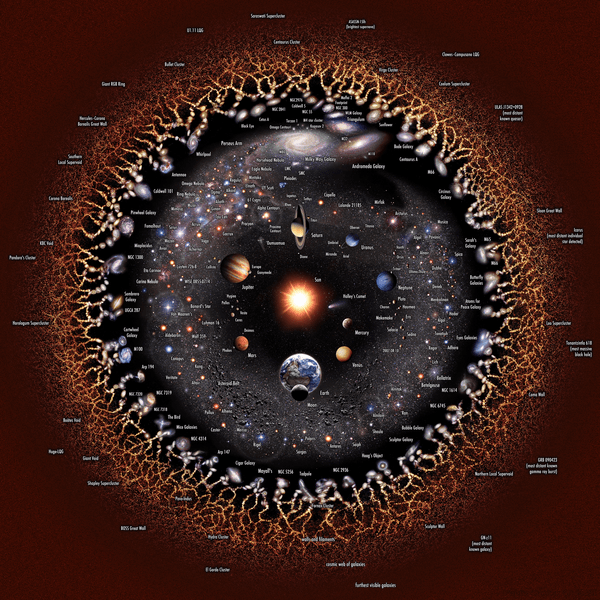
Image credits: Pablo Carlos Budassi, CC BY-SA 4.0 https://creativecommons.org/licenses/by-sa/4.0, via Wikimedia Commons
The Universe was already known to be expanding from the impact of the Big Bang. However, it was thought that the expansion would slow down at some point and the universe would start contracting into the singularity it came from, just like breathing. But it was discovered recently that the rate of expansion has suddenly increased. How do we know this? The galaxies are going farther away from us at an increased rate. Why is this happening? Is it a hint that an unknown material is at work?
What is the unit of this expansion that keeps appearing in the news?
If the universe keeps expanding at this rate, the universe may double in size in the next 10 billion years! If you see the news, they say that the rate of expansion is 73 kilometers per second per megaparsec. It is not a usual unit of distance we are aware of, and neither does it correspond to the explanations I gave in my article “How big is outer space for real?“. Then how can we picture it?
Let me use a common example. We buy clothes that have some elasticity. But with continuous use, they seem to lose their elasticity and become loose. So, if you draw a line of 1 centimeter on your dress with a permanent marker when it was new, and you kept wearing it over and over again for years. Then you measure the line with a scale after say, 10 years and it is now 2 centimeters. So, every centimeter of your cloth is expanded by one millimeter every year. Then, what was the rate of expansion of your cloth? It is 10 millimeters per year per centimeter.
We know by now that space doesn’t have any ground against which we can measure distances and that it is too big to pinpoint a single point in space. So, we use the same analogy as above. We take a section in space that is one million parsecs big. Then we observe the same section continuously, and we note its expansion. This turned out to be 73 kilometers per second. Hence, each million parsecs section of space is expanding at the rate of 73 kilometers per second. And then of course the final result is a summation of several data and we get the result of 73 plus or minus 2.1 km per second per megaparsec.
But why is it happening?
Scientists believe that it is a new kind of physics that hasn’t been discovered yet. As far as we know, 96% of the universe we can see is made up of dark and unknown parts, which have been termed dark matter and dark energy. This expansion could be fueled by this dark matter and energy. But we don’t know yet.
What is going on with Neptune?
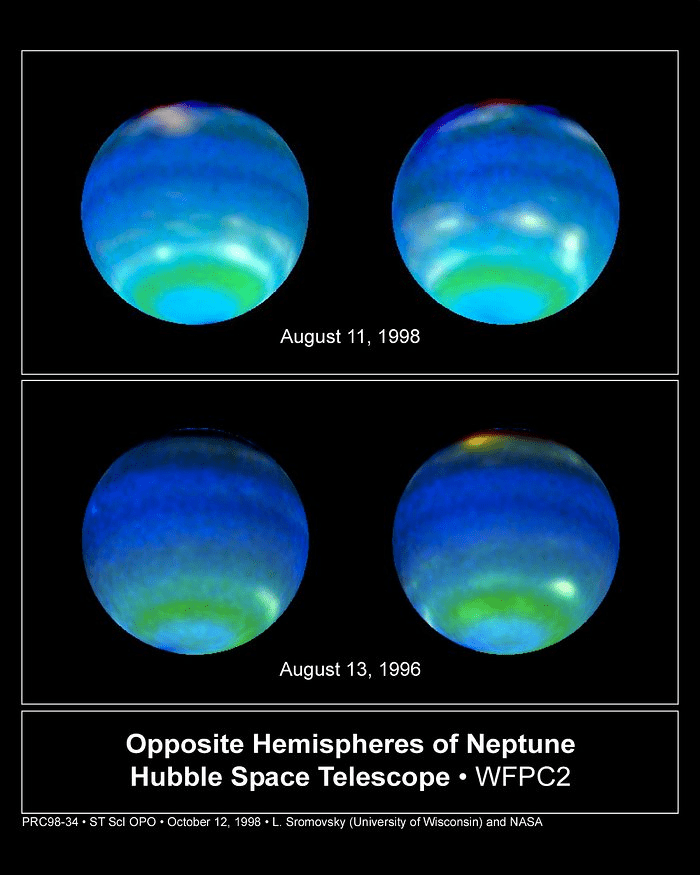
The planet Neptune’s axis is tilted by 28 degrees with respect to its plane of orbit, and hence has seasons just like the Earth. We have five major seasons on the Earth – summer, monsoon, autumn, winter, and spring. Just like that, Neptune has four seasons, and each of them lasts 40 years! But looks like it’s not just the Earth that is experiencing climate change. Neptune’s sunny Southern hemisphere is cooling down when it should be heating up. The climate of Neptune experienced a cooling of almost 8 degrees Celcius (or 14 degrees Fahrenheit) until 2018 and a sudden shooting up of temperatures by almost 11 degrees Celcius (or 20 degrees Fahrenheit) between 2018 and 2020! Such dramatic fluctuations in temperatures were not expected at all. Right now, there isn’t much to explain all this activity. But with the James Webb Telescope now operational, more precise information and further explanation can be expected.
I have a question for you. Do you think we are surrounded by alien civilizations or are we alone? Both scenarios are scary, but which do you think is true? If you think there are aliens, do you think we are being observed at this moment by alien species from higher dimensions? Who are they? Point to ponder?
Keep up the curiosity! Be mystified! Be inspired! Be Priya-fied!
Discover more from Priyafied
Subscribe to get the latest posts sent to your email.


Thank you for introducing a lot into my knowledge library😍
LikeLiked by 1 person
Perfect💯👍👏 article to ponder what next? 🤨🤔
LikeLiked by 1 person
Thank you Appa 🤗! Next step to understand the unifying force of nature 💨
LikeLike