


I read a recent news that a new constellation named Ophiuchus has been added as the 13th zodiac and the sun signs have changed to accommodate the new member of zodiac. I curiously took up reading and researching further on this subject, and I reached valuable information that will inspire me to continue my study. Astrology is a very deep study, highly complex theory, minutely precise calculations and at the same time, a widely debated field. Billions of people follow it, while there are probably as many of them who do not. The non-believers claim it to be pseudoscience. Although, I do not believe in the term pseudoscience itself. A scientific evidence demands mathematical or logical proof, making the proof mathematical or logical, not scientific. So when there is nothing “scientific” about a scientific proof, the concept of pseudoscience itself seems flawed.
Astrology is a very mathematical concept for those who understand it, or want to understand it. And without want of understanding, any concept would become illogical. For the general public, astrology has always been an astrologer making predictions about someone’s life, while looking at a chart-like diagram drawn using only time, place and date of birth of that person in the most common cases. The predictions are a set of jargon terms that go over your head and remedies are a set of instructions that have no connection to your problem itself as per your point of view, but will help you in some way. For most of you, who have never gone beyond this thought, how can you even judge astrology for “pseudoscience” or not, when there has been no disproving as well?
Astrology has been around since the very beginning. There are different concepts of astrology used in the world today. Most of what the western countries use is Tropical astrology and its derivations. While the Eastern countries continue to use their traditional system based on Sidereal Astrology. Tropical Astrology is probably the simplest and to an extent, inaccurate form of astrology. This is because all that is required to generate a sun-sign horoscope is the date of birth according to the Gregorian calendar. It depends on the position of the Sun against the different constellations with respect to the Earth. On the other hand, the basis of Sidereal Astrology is measurements around the ecliptic with respect to the fixed stars. While the debate of two questions was already gripping the world i.e. whether or not to believe astrology and which type of astrology to use, the recent news regarding the new zodiac has added fuel to the fire.
Although Ophiuchus has been around always and has also been described and documented well by astronomers and astrologers alike, the recent “news” of Ophiuchus being added to the existing the zodiac family and hence, the star signs being “changed” as the dates were adjusted to include the new member, caused an uproar. Ophiuchus is one of the 88 constellations known presently that cover the entire Northern and Southern sky.
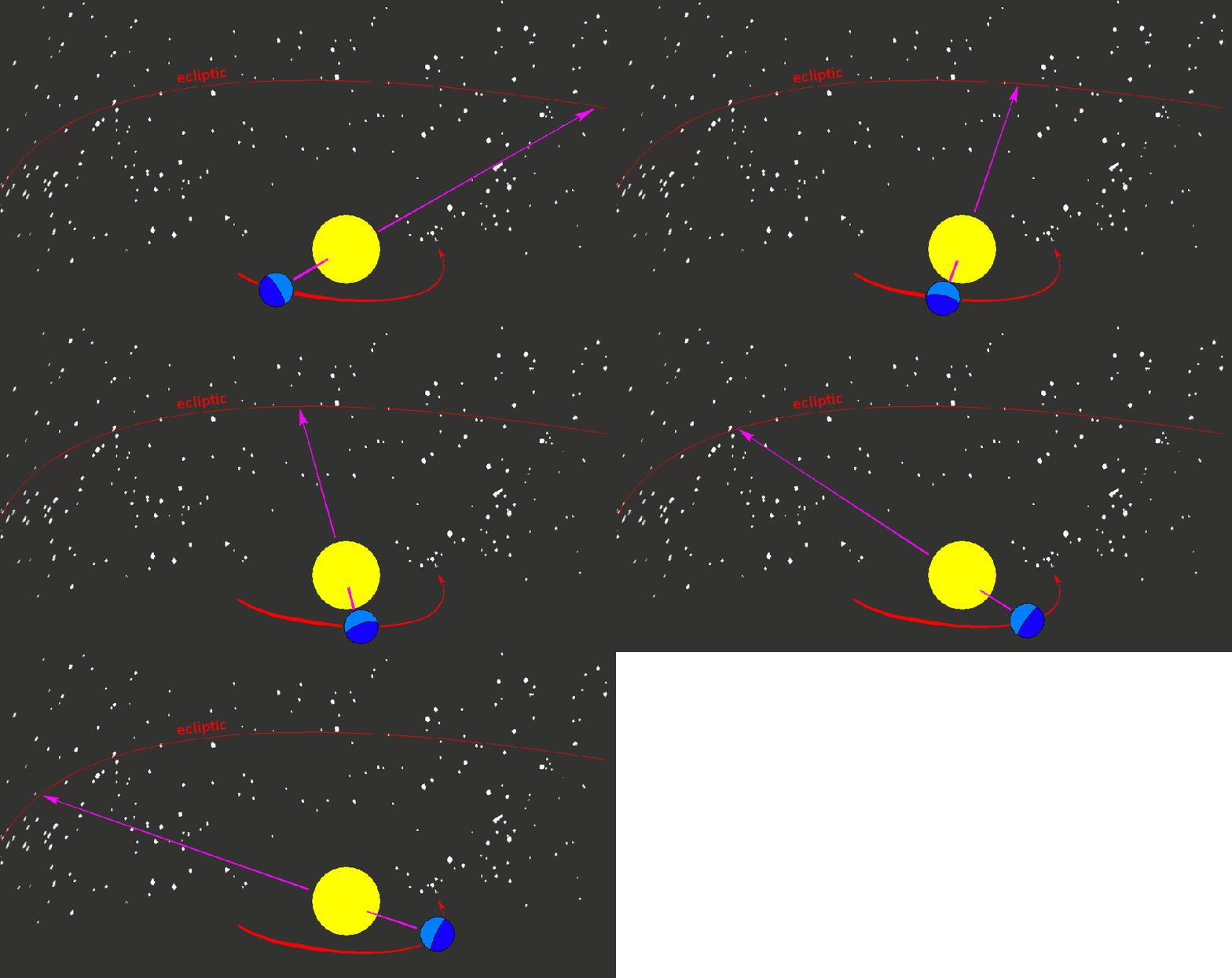
Before I continue on this topic, there are a few terms that should be known:-
- Ecliptic: The plane of the Earth’s orbit around the Sun. If you see from the perspective of the Earth, it will appear as the path of Sun around the Earth in the celestial sphere (Check out the image above).
- Constellation: A group of visible stars that together form a perceived outline or pattern (Known as Rashi in Vedic Astrology).
- Constellation family: A collection of constellations that are sharing some defining characteristic.
- Nakshatras: Fixed sectors of stars along the Ecliptic, with each sector (13°20′ each) being named after the most prominent star in that sector.
There are many constellation families – Zodiac, Hercules, Ursa Major, Perseus etc. In the Zodiac family are the 12 constellations (Aries, Taurus, Gemini, Cancer, Leo, Virgo, Libra, Scorpius, Sagittarius, Capricorn, Aquarius, Pisces) and hence they are commonly called Zodiac signs (Rashis in Vedic Astrology), because the ecliptic passes through them. The debated constellation Ophiuchus lies in the Hercules family. Why is it being added to the Zodiac then? This is because the ecliptic also passes through a part of Ophiuchus while crossing the Zodiac band. This is the only argument being used in support of it.
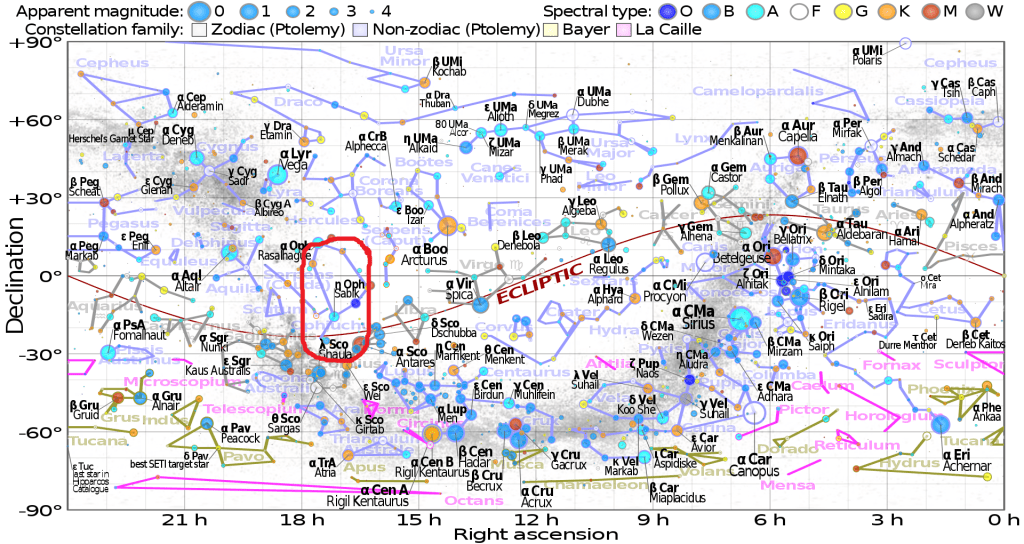
However, there are several reasons why this constellation doesn’t feature among the known zodiac constellations. Take the following two points into consideration:-
- If you see the image above that shows the families of constellations and the Ecliptic, you can clearly see that the Ecliptic passes through the Zodiac family and only through a small tail of the Ophiuchus (marked in red).
- Apart from this, the zodiac division in Tropical Astrology is based on the time taken by the Sun to pass through the different constellations, whereas the Sidereal Astrological concept of division of constellations is equal in the sky (30° each) and each section is named as per the major constellation in that section.
Either way, Ophiuchus doesn’t stand a chance to be featured among the Zodiac. The reason why I began with the definition of Tropical and Sidereal Astrology is because these calculations work on Vedic Astrology (which is a system using Sidereal Astrology concepts) and falls flat for Tropical Astrology, also revealing its limitations. This observation disproves the accuracy of sun sign based predictions as it doesn’t take into consideration something called “Precession of the Equinoxes”. This is basically the wobbling of the Earth along its axis as it spins like a top. This results in different stars being the pole star over centuries, and each cycle repeating over 25,868 years. The following video will help you visualize the exact meaning of the concept.
Notice how the axis of the earth is pointing to different locations in space over the entire cycle of 25,868 years. This results in zodiac constellations not being in the same degree with respect to the Sun as seen from the Earth. This results in a crucial mismatch of predictions based on Tropical Astrology. However, Sidereal Astrology works around the problem by considering the positions of the zodiac against the backdrop of the fixed stars in real time (known as Nakshatras), and not on the wobbly earth, thereby eliminating the problem from the roots.
This means that neither Ophiuchus or in future, discovery of any other constellations also would affect our Vedic Astrological predictions. This is a topic that requires detailed analysis and is out of the scope of this article. I will approach the concepts behind Tropical Astrology and Sidereal Astrology in a future blog. Stay tuned on my page for further information on this subject!
For now, Ophiuchus has been proven not to feature as a zodiac, and Vedic astrological calculations still remain undisputed in this regard.
Stay mystified! Stay inspired! Stay Priya-fied!
Cover image credits – ©By ESA/Hubble, CC BY 4.0, https://commons.wikimedia.org/w/index.php?curid=8788068
Discover more from Priyafied
Subscribe to get the latest posts sent to your email.

 Priyafied
Excellent you made your point with supportive astronomical events happening, I personally fully agree and endorse your views . Keep writing stay blessed.
On Thu, 23 Jul, 2020, 12:58 pm Get satisfied, Get detoxified, Get mystified, Get Priya-fied…., wrote:
> R Priya posted: ” I read a recent news that a new constellation named > Ophiuchus has been added as the 13th zodiac and the sun signs have changed > to accommodate the new member of zodiac. I curiously took up reading and > researching further on this subject, and I reached val” >
LikeLiked by 1 person
Thank you Appa 😊😊
LikeLike