


Remember the strange things we saw in this world in my older article, “Stranger Things in our World“? There are even more bizarre things that happen or exist in our world and universe that are sure to blow your socks off. Let’s roll!
Blue lava
Lava is known to everyone as the red magma that erupts through volcanoes from under the Earth’s crust. But can you believe that blue lava is also seen in some places?
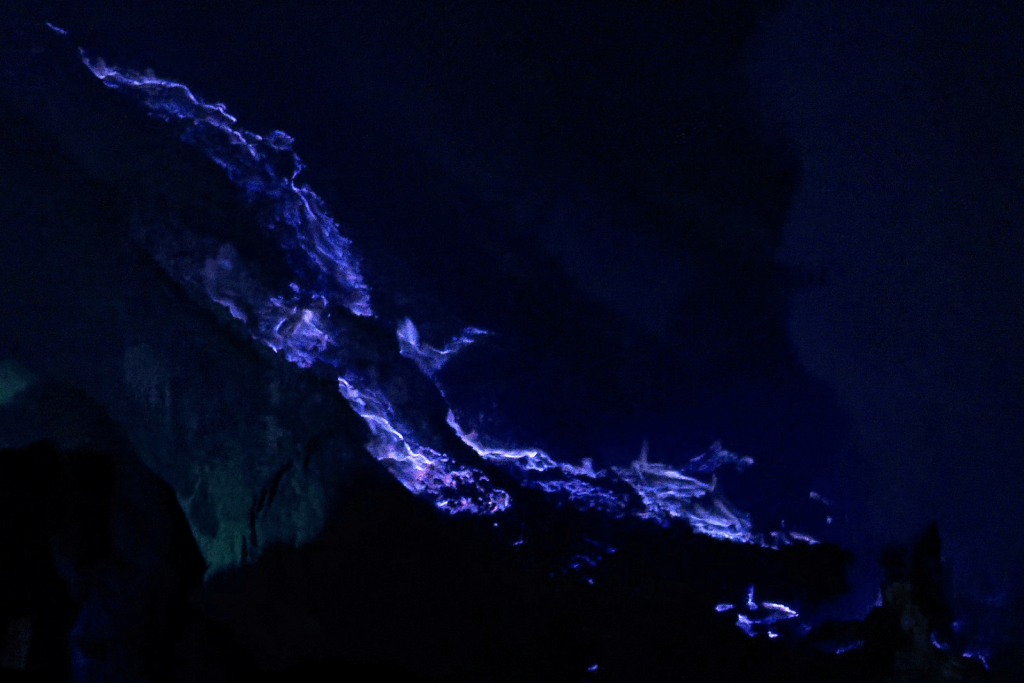
Do you see this brilliant blue lava? This is not a filter. It is an actual image taken by Thomas Fuhrmann of lava erupting from Mount Ijen in Indonesia in 2018. But why and how it is blue? The “blueness” comes from the burning sulphur. Mount Ijen has one of the highest levels of sulphur in the world and is the site for sulphur mining. When the hot magma and sulphur from the volcano hit the air, it is already at over 600 °C. As soon as it comes in contact with air, the sulphur burns a brilliant blue. However, this is mostly visible only at night due to the blue hue and would appear in the usual reddish-orange colour during the day.
So, the best time to see such blue lava would be close to sunset since most volcanoes cannot be visited at night.
Invisible fire
I had a thought in my head that it’s a good thing fires are a visible phenomenon. Otherwise, nobody could help us since they do not see the “invisible” fire burning us. Turns out, invisible fires are a thing. Imagine burning from a fire that you can’t even see. That’s true! Watch this video:
Methanol is slightly more difficult to burn as compared to gasoline, but it is flammable. The worst part is that it burns a light blue flame that is very difficult and almost impossible to see in daylight or any light. Flames in general, can have temperatures ranging from 600 to 3000 °C, depending on the molecular constitution of material burning. The differences in material and temperature are the reasons the stove flame is different from a candle flame. But an invisible fire doing the same damage as a normal fire is a new fear unlocked!
A useful tip: Methanol must be kept cooler than 470 °C and methanol fires can be put out by large amounts of water, which works by bringing down the temperature of methanol and simultaneously reducing the heat.
A star older than the universe?
What if I told you that scientists have discovered a star that is older than our universe? I am not making this up. Scientists have indeed found a star that is estimated to be 14.45 billion years old, which is more than the current estimated age of the universe after the Big Bang (13.797 billion years).

Our universe has formed from the Big Bang, a conclusion that is the result of several years of work by astronomers and scientists. The light that we receive from these faraway stars and galaxies is tracked over time, and it was seen that their wavelength increased (redshift). This implies the objects going farther away. And the farther the objects were, the faster they were moving away. So, the expansion of the universe was accelerating. The light is also analyzed to understand the different materials existing in those stars (for example, hydrogen, iron, etc.). Based on these factors and the cosmic microwave background, the age of the universe and individual stars can be estimated. And hence, the age of this star called Methuselah (named after the longest-living Biblical patriarch) was determined to be around 16 billion years initially. Thereafter, more research into the chemical components of the star showed that the ratio of oxygen to iron was higher than predicted, which lowered the age of the star to 14.45 billion years because the content of oxygen is predicted to be much lower during the early stages of the formation of the universe.
However, this is still older than the age of the universe. Counting errors and uncertainty in measurement gives us more room for comfort to be within the range. New research conducted as recently as 2021 by Australian researchers using different models of star formation and including newer observations estimates the age of Methuselah to be around 12 billion years, which finally brings the numbers within the range of believability.
Do you think the star can be older than the universe? Why?
All the components of the universe seen together in one image?
What if you could see all of the universe including the components that the human eye cannot see? Recently, we saw results from the James Webb Telescope, Hubble Telescope, and Chandra Telescope combined to give us a breathtaking image! See for yourself:
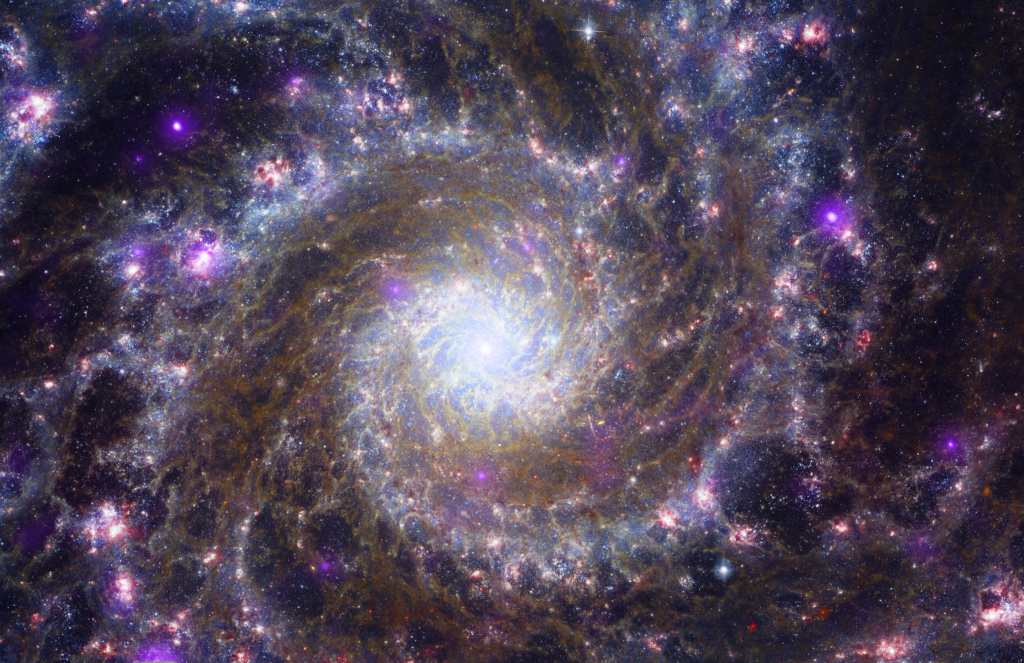
This is the M74 Galaxy. It is another spiral galaxy like our Milky Way galaxy and is about 32 million light years away from us, which means that light from this galaxy will take 32 million years to reach us on Earth. It is very dim, which is why is also called a phantom galaxy. So, what is so special about this image? The James Webb Telescope is able to capture the gas and dust outlines, the Chandra Telescope provides excellent visualization of stars using X-Rays, and the Hubble Telescope is also able to capture the additional stars and the dust lanes. Altogether, by combining the data of JWST, Hubble, and Chandra Telescopes, we are able to see this galaxy in magnificent detail. All that the telescopes are able to see is made visible to us by mapping those colours to the wavelengths that we can see. The procedure is similar to changing the octave of a music piece to the frequency humans can hear. Learn more about the processing of the images from telescopes here – Beyond the visible: Giving colour to our universe.
And these are just the photons and there exist at least 16 types of particles that we know of already (Know more on this in under ten minutes here – The Standard Model: How the universe works). Imagine being able to see all the types of particles and energies that exist.
Keep in mind that there are over 100 billion suns in this photo. So, you can understand that the essence of being able to see the universe in its entirety will be unparalleled!
दिवि सूर्यसहस्रस्य भवेद्युगपदुत्थिता |
यदि भा: सदृशी सा स्याद्भासस्तस्य महात्मन:
divi sūrya-sahasrasya bhaved yugapad utthitā
yadi bhāḥ sadṛiśhī sā syād bhāsas tasya mahātmanaḥ
If thousands of suns were to blaze forth together in the sky, they would not match the splendour of that great form.
अनेकबाहूदरवक्त्रनेत्रं
पश्यामि त्वां सर्वतोऽनन्तरूपम् |
नान्तं न मध्यं न पुनस्तवादिं
पश्यामि विश्वेश्वर विश्वरूप
aneka-bāhūdara-vaktra-netraṁ
paśhyāmi tvāṁ sarvato ’nanta-rūpam
nāntaṁ na madhyaṁ na punas tavādiṁ
paśhyāmi viśhveśhvara viśhva-rūpa
I see the infinite form with no beginning, middle, or end of the Lord of the universe, who is the universe Itself.
Carbon dioxide is important for survival

Can you tell me why we surface out of water when we are out of breath? I am sure you thought that it is because we run out of oxygen. I thought so too, but it is only partly true. And as we know, half-baked knowledge is worse than no knowledge. While you are underwater, your body is using oxygen and the level of oxygen is coming down. But that is not what forces you to come up for air. The body measures oxygen in the body indirectly via the level of carbon dioxide. And when carbon dioxide starts filling your lungs with decreasing oxygen, your body demands you to breathe.
It is not very difficult to test out but do it only if you have healthy lungs and don’t have breathing issues. Breathe in some air into your lungs and hold it till you can. When your body pushes you to let go, just breathe out some air and stop again. You’ll notice you are able to hold your breath a little longer. But you can only do this a couple of times until the oxygen runs out and you pass out. Why? Because you had no oxygen left but also didn’t have too much carbon dioxide in the lungs for your body to give you an alarm to breathe. Similarly, hyperventilating (rapid breathing) before going underwater will decrease the level of carbon dioxide and it is easier to hold your breath. But oxygen is still less and if you are in the air, you will pass out and breathe again. But if you pass out underwater, it can be fatal.
Bonus: Wheel Paradox
This is an interesting paradox that appears in the Greek work, “Mechanica” and is attributed to Aristotle. The problem looks simple on the face of it, but do you think you can solve it?
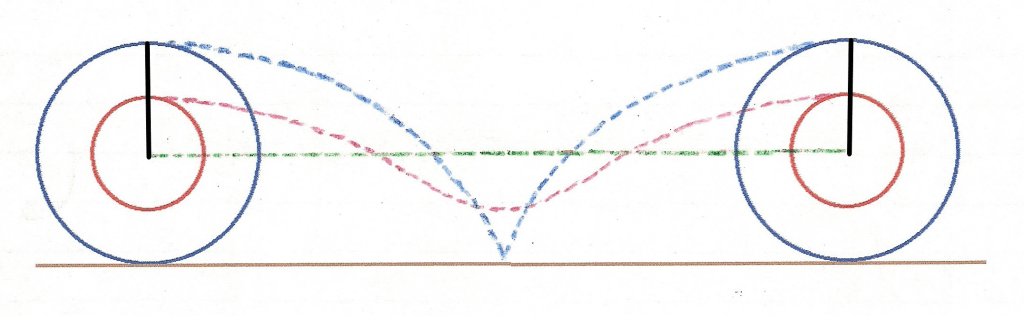
There exist two wheels, one inside of the other. We all agree that if the circumference of a circle is pulled apart to form a line, the circle inside will make a smaller line than the circle outside. And let’s say that we roll it over once. Something like this:

How are these lines equal when the circumference of both circles is different? Can you answer?
The answer is that the path of both wheels is not actually a straight line. They are curved lines, which have different lengths as a result of the curve. The problem lies in perspective.
Still unclear? Look at this gif below. Isn’t the larger circle rotating faster than the smaller circle?
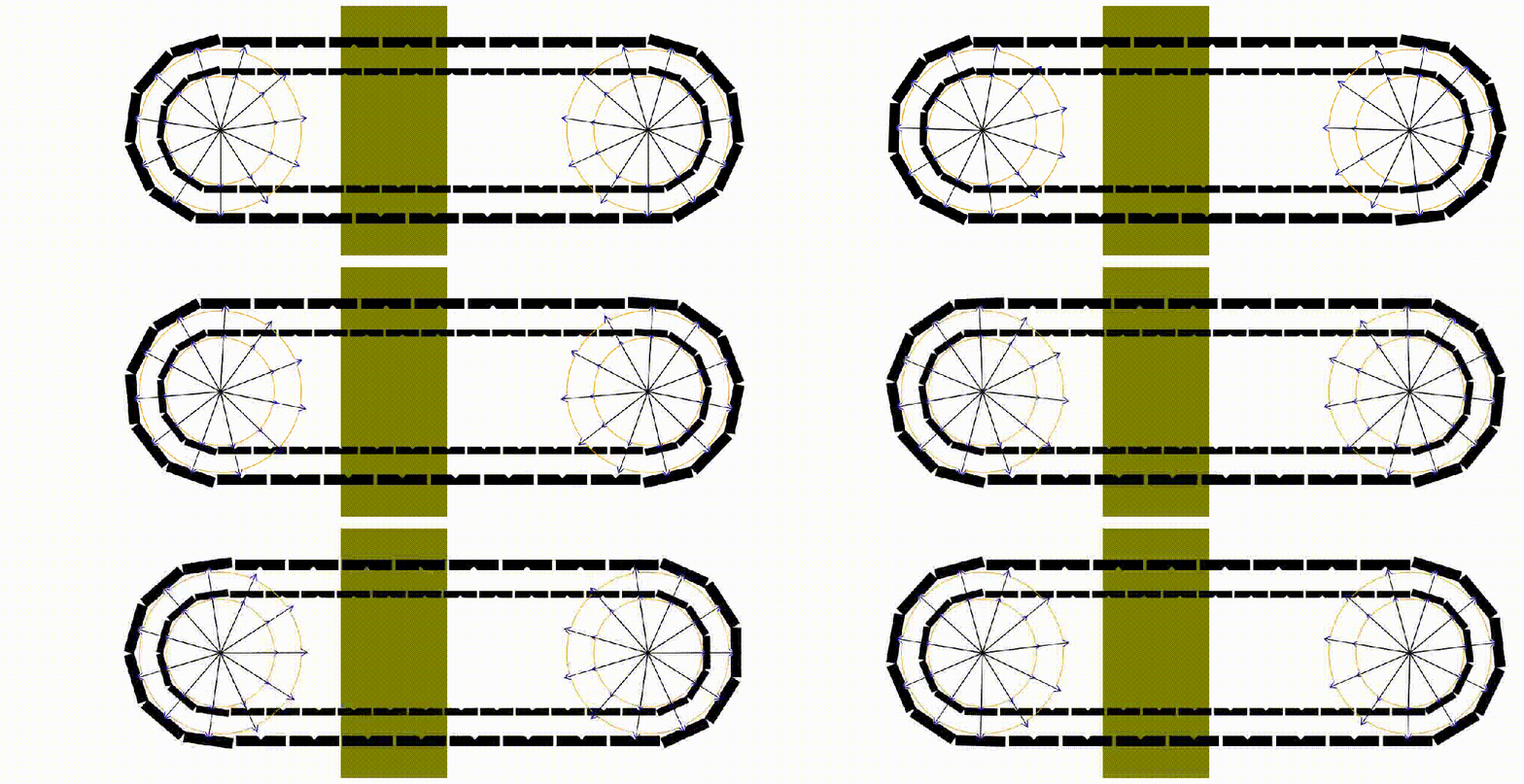
The idea is similar to the case of runners being positioned unequally on different lanes of a round racing track so that all of them have the same time to cover unequal distances. And with our wheels, we are giving more time to the inner ring to cover the same distance the outer ring is covering.

Do you also know any weird, strange, interesting, or mid-boggling facts that will knock my socks off? Let me know!
Be Priyafied!
Discover more from Priyafied
Subscribe to get the latest posts sent to your email.

 Priyafied