

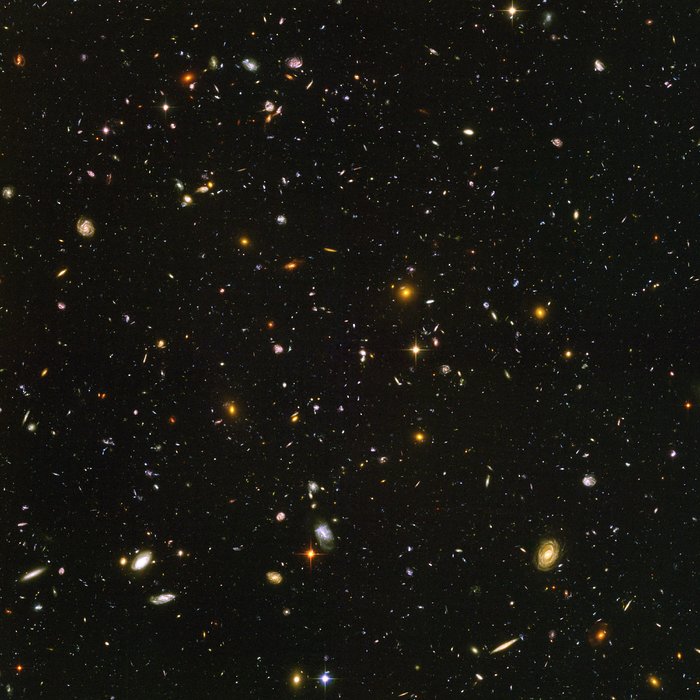
The cover image is the Hubble deep field capture of nearly 10000 galaxies that are billions of light-years away. Credit: ESA/Hubble
But most of us can’t really picture what billions of light-years actually imply. This is the topic I want to address in this article. How can a common man visualize outer space? Hilariously, if you ask someone who is high on alcohol or substance, they will tell you the magical trips they have taken of the universe. But no, that’s not the kind of universe I am talking about.

We all are largely aware of the general structure of the immediate space outside our planet. I think I can confidently begin with the assumption that we all know the general layout of the solar system: –
- We live on a planet called the “Earth”
- The star closest to us is our sun and is called “Sol” in Latin (Hence the sun-related phenomena is called “solar”, like the solar system)
- The Earth is the third planet from the sun
- We get the natural heat and light from the sun
- There are 7 other planets in our solar system, and 5 main dwarf planets
- All planets revolve around the sun
- All planets other than Mercury and Venus have their moons, which revolve around them
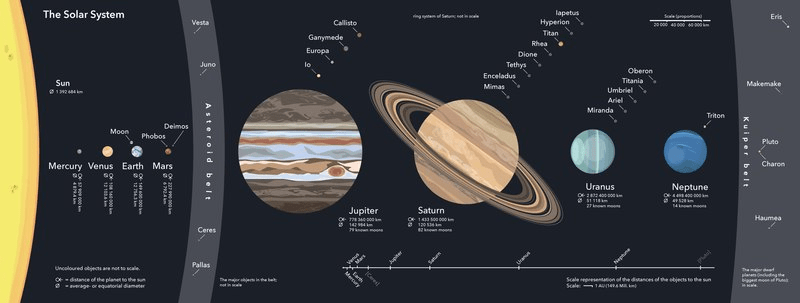
Beinahegut, CC BY-SA 4.0 https://creativecommons.org/licenses/by-sa/4.0, via Wikimedia Commons
All this is very common information. But do we really understand how far apart they are? I had this realization from the Flat Earth Theory. If you haven’t already, go and check out this article where I take you through a holistic view of the flat Earth theory, and why it cannot work in simple terms. The main point of argument given by the Flat Earthers is that they are unable to see the curve with their own eyes, even at the range of several hundred kilometers of visibility, and hence the Earth is flat. However, the Earth is way too big to see a few degrees of curvature over several hundred kilometers with naked eyes because refraction also plays its part.
How large is the Earth? Why can’t we see its curvature if it is curved?
Complete article: The Earth is Flat
For example, we consider mountains in line on top of the surface of the Earth.
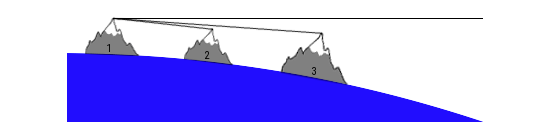
Would you really believe that an average human being would be able to resolve an angle of 0.01 degrees over a distance of 10 kilometers? So it appears mostly flat, but it is not flat at all.
This got me thinking that maybe the root cause is that people are not able to get a real feel of how big Earth or even other celestial bodies are in space. In this article, I will give you a visual feel of being in space by taking you there.
How do we measure space in numbers?
Let’s go step by step. Firstly, how do we measure distance? You will say meters, kilometers, yards, miles, and so on. Sure, but what happens for distances much much higher? Let’s say the distance between your home and office is 10 kilometers or 6.2 miles. It would be very tedious to tell someone that you travel 10000 meters or 10936 yards. So you say 10 km or 6.2 miles. When distances become so large that using kilometers or miles becomes tedious, we bring light into the picture to make our measurements easier.
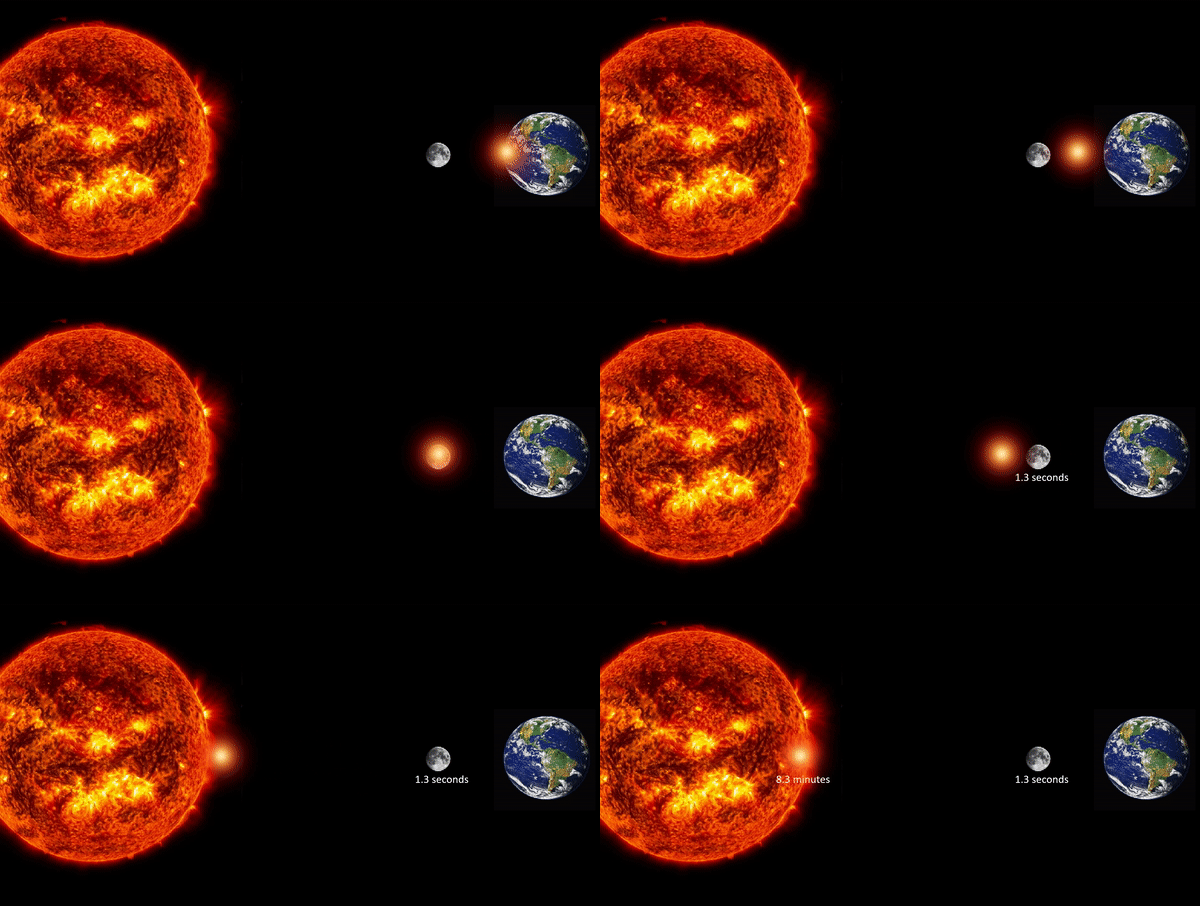
It is like using light as our spaceship. The speed of light is constant in space, so, it is easy to say that something in space is a few light-years away. It essentially means that if we were to travel at the speed of light, this is the time we will take to reach some celestial body, and they combine to make a unit of distance. Hence, if we travel at the speed of light, we will reach the moon in 1.3 seconds, the sun in 8.3 minutes, mars in 12.7 minutes, and so on. The distance traveled by light to travel a particular point is called light time i.e. light seconds, light minutes, light-years, etc. Despite how it sounds, it is a unit of distance and not time.
What happens when light-years become tedious? Let’s go on to larger distances now.
It takes about 8 minutes on average for sunlight to reach Earth. This distance is called 1 Astronomical Unit (AU). The distance between the Earth and Sun varies over the entire year because they are moving in space obviously, but it is approximately equal to 150 million km or 93 million miles. To put this in perspective light is covering 150 million km (93 million miles) in 8 minutes. Light is the fastest entity in the entire universe. It covers 300k km in one second. On Earth, we can use kilometers or miles because it is measured with respect to the ground, which is constant. But, it is easier to measure distances in space with respect to the time light takes to travel between two points because, in the vacuum of space, we cannot effectively measure in traditional units due to the lack of a ground or base.
One step higher…
When the distance becomes even larger for Astronomical Units, we use parsec (about 3.26 light-years). This is used mostly to measure distances outside of our solar system. Within the Earth, we use meters and kilometers, or yards and miles. Similarly in space, the three main units used are light-years (ly), Astronomical Unit (AU), and parsec (pc).
Trip through space. What will we see?
Now that we know what the measurement is, it is time to visualize it. All of the visuals, screenshots, and videos have been taken using the software “Space Engine“. Interested people can check it out. In general, the distance of any celestial body from the Earth is given in light-years or kilometers (average). But that is not helpful if you can’t visualize it.
All these are visuals you would actually see if you go up to space in this exact distance and layout. This is the Earth in space. The dimensions, distances, and scales are maintained here.
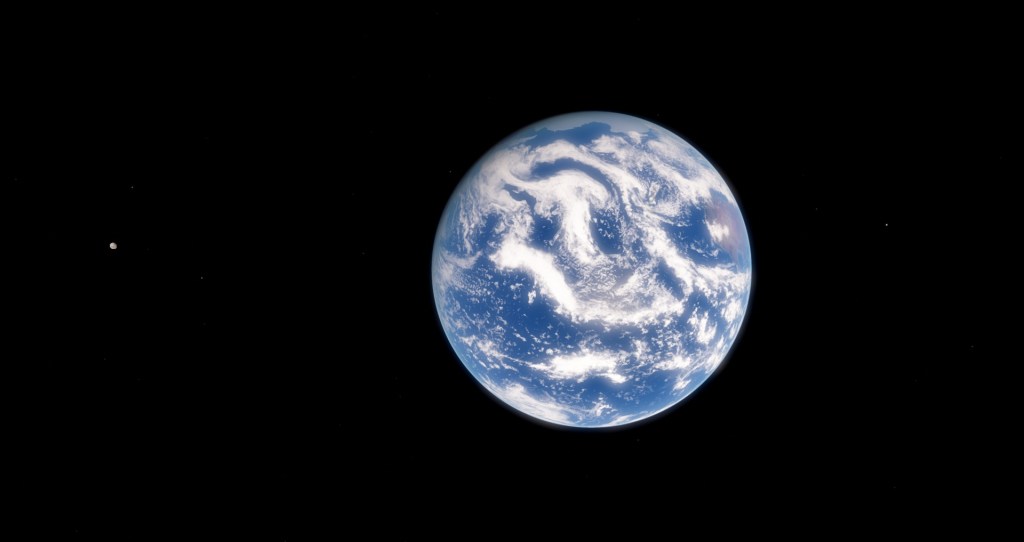
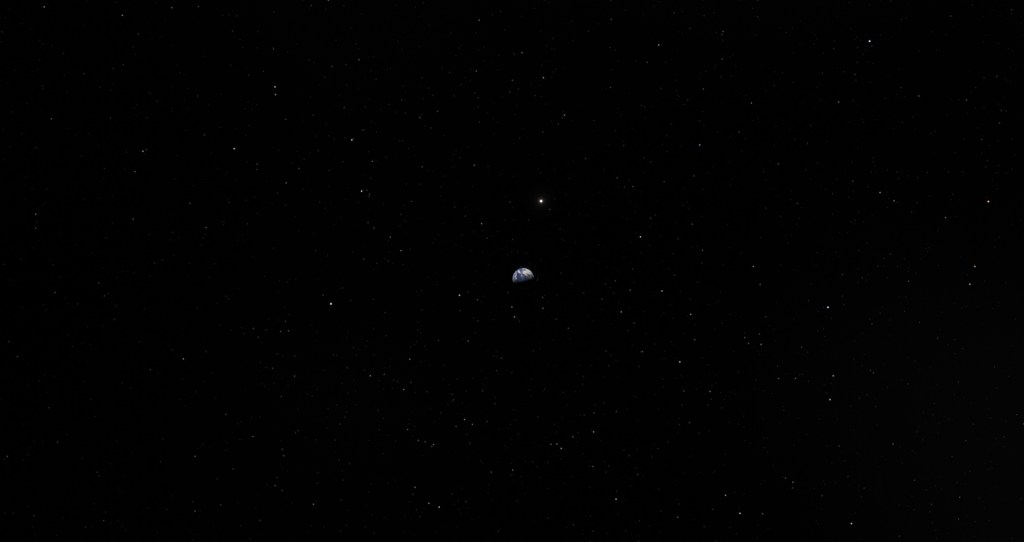
And if you still think it is not too far, this is what the planets of our solar system and the Sun look like if you were standing on the moon. Far, right?
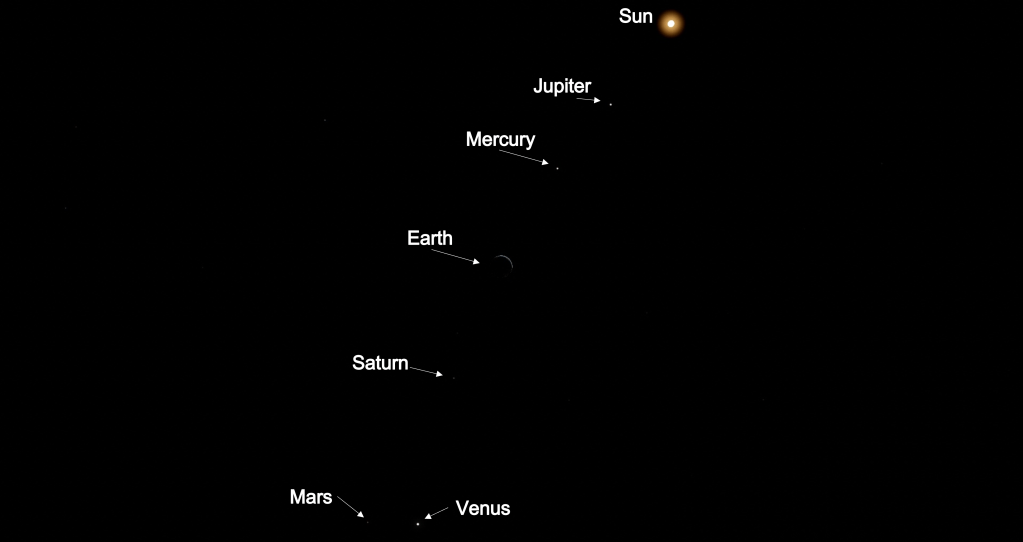
Let’s go over to the Moon now. This is the Moon in space.
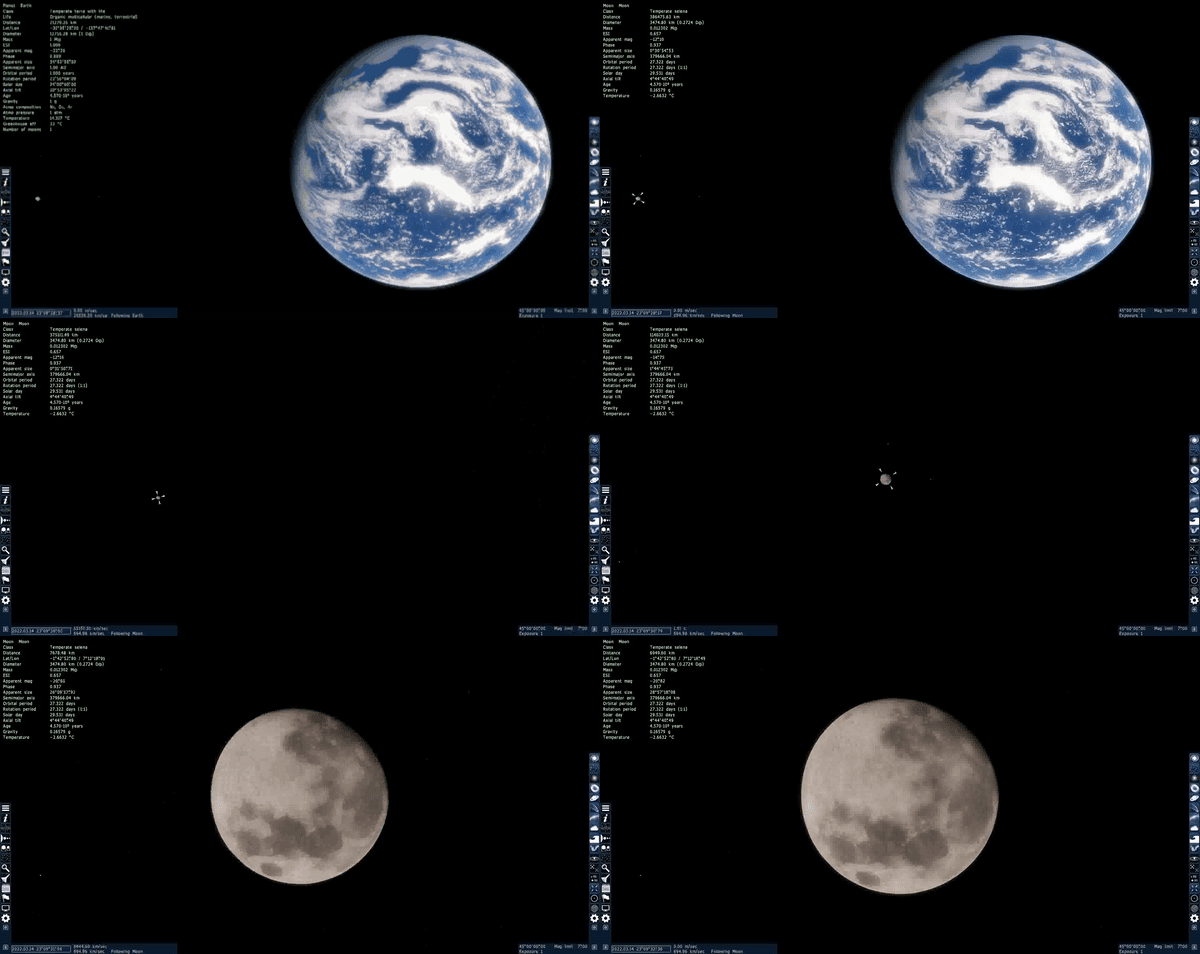
But you can’t really picture the distance in your head because you cannot see your size against the Earth and the Moon. In reality, you can fit approximately 30 Earths between our planet and our moon. And it is gradually going away from us at the rate of about an inch per year, which may seem like a lot but is not too much. This is what I want to explain today. I will make it easier for you to visualize that. We will look at the same animation as above, but with a twist. We will become astronauts with a spaceship and fly from the Earth’s surface and look at the moon.
But with a twist!
When you fly across continents, say from Asia to America, it takes you an average of 15 hours in a commercial flight, despite the flight covering about 1000 kilometers or 600 miles per hour. If we use the same plane to, for example, get to the moon, we would take at least TWO WEEKS! So, let’s deploy the world’s current fastest aircraft – the Lockheed SR-71 Blackbird, which travels at 3500 kilometers or 2100 miles per hour. In principle, it will cover the distance between Asia and America in about 4 hours. We will build an engine that is 100 times faster than that. Up we go!
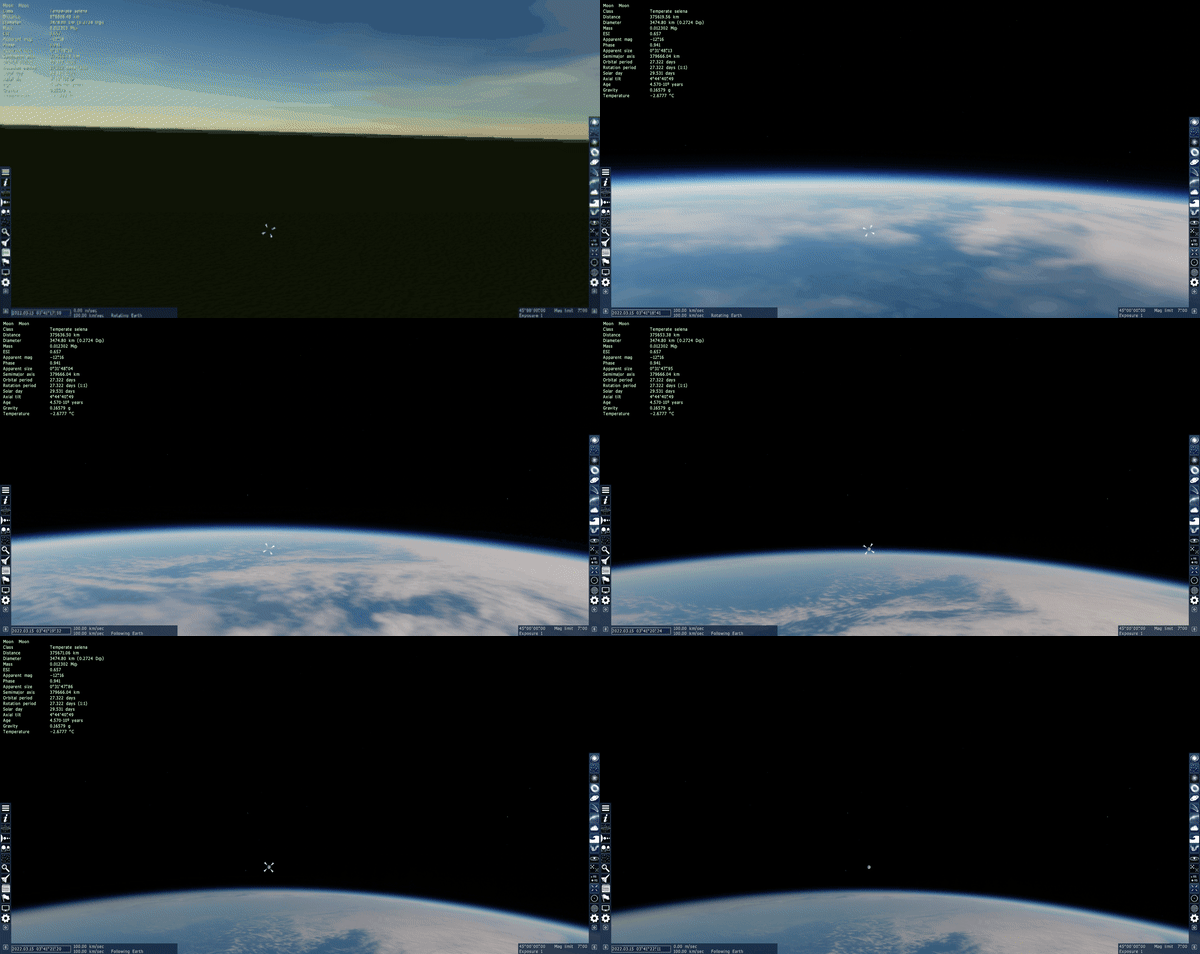
So, how much time does it take to go to the moon at the original speed of the fastest aircraft in the world? It will still take more than 4 days. That’s too long to fly continuously. If we use our 100 times faster engine, we will take an hour. But that might be too long to see here. So to speed up, I fixed the acceleration of the engine at 1 meter per second squared, so that our jet will increase its velocity by 1 meter per second every second, and sped up the video. Watch below the sped-up video:
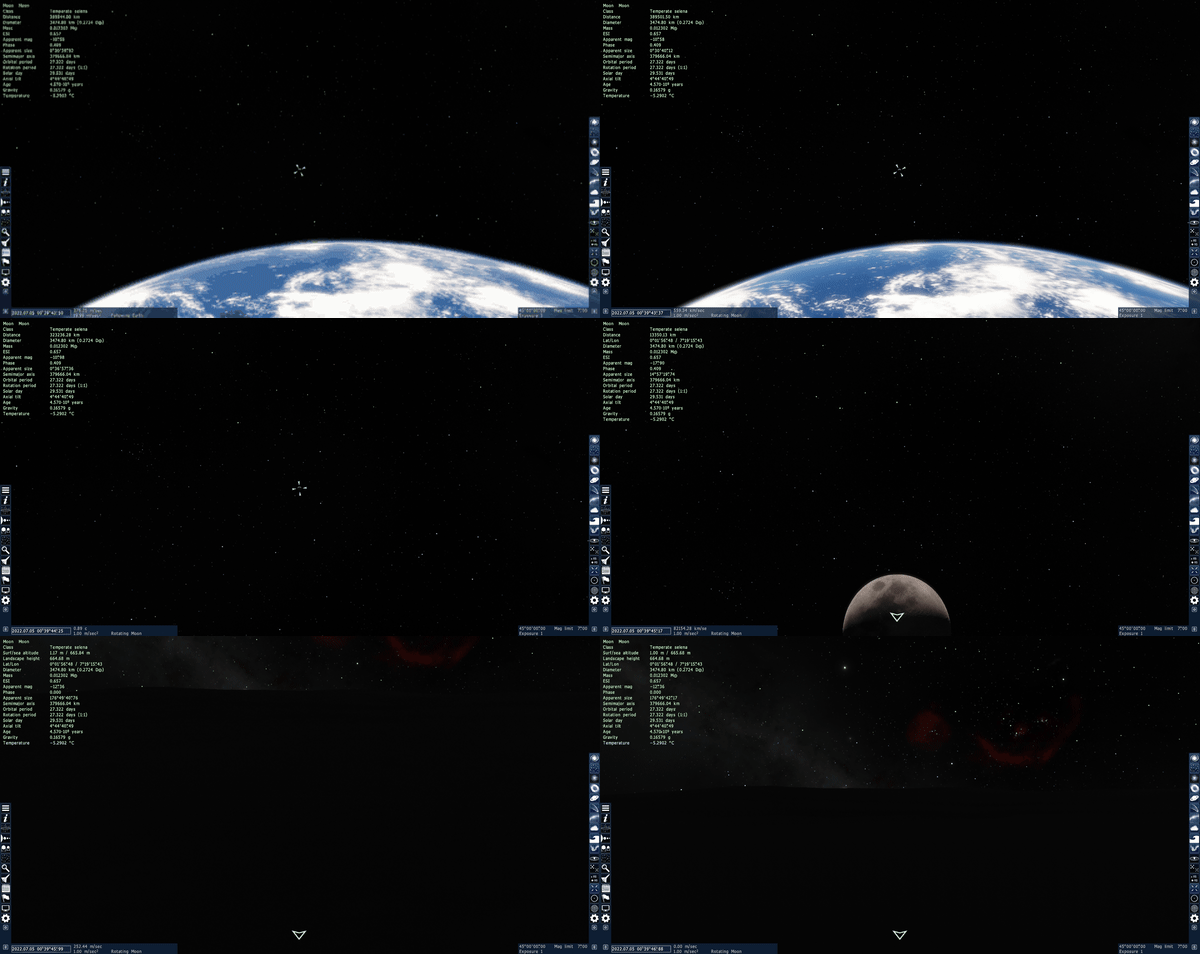
Likewise, everything is farther and farther away. If you notice, once the Earth is out of view, you don’t really see the movement of going forward for a while unless you are close enough to the moon. That happens because space is mostly empty, and we don’t have anything constant to measure the movement against.
Do you know how far Mars is in reality? If you turn on the flashlight and point to a wall far away, the wall lights up almost immediately. This tells us how fast light is for real. So, if I tell you that even light takes more than 12 minutes to reach Mars from the Earth, you can imagine the distance from Earth to Mars. The other planets are much farther away. I said in the beginning that the galaxies seen in the cover image taken by the Hubble Telescope are billions of light-years away. I think you understand now that light is taking billions of years to reach those galaxies. So, imagine how far they are in actual reality.
Do you realize the huge vastness of the empty space around Earth? You are basically an insignificant part of the universe physically. In order to understand the full potential of the universe you live in, the only way is to lift your mental caliber, and eventually help yourself look beyond the constraints of this planet. So, whether you decide to contribute to the universe or exist and perish over and over again, is your choice. Point to ponder?
Be mystified! Be detoxified! Be Priya-fied!
Liked what you saw? Would you like to see other Earth-like planets? Or any far away galaxies? If you’d like to see something specific in the outer space, let me know in the comments. I will post a video or photo on my social media handles.
Discover more from Priyafied
Subscribe to get the latest posts sent to your email.

 Priyafied
Awesome👏👍 ride of the solar system🌞✨🌎✨🌝, looking forward to brahmanda ride next time. Great work.
LikeLiked by 1 person
Thank you Appa 🤗😅
LikeLike