

In part 1, we figured out who we are and what our capabilities are, based on our ancestors. We established how genes work in simple words, and how you can find your ancestry based on your particular requirements – Paternal lineage, maternal lineage, or ethnicity. If you haven’t read it yet, then please do by clicking here. In the final part, we take a look at what we can do using this information.
You know your ancestry. Now what?
You know your ancestry now and have identified your capabilities and shortcomings. What more can be done with the information on your genetics? In short, a lot more. Let me elaborate. As I mentioned earlier, DNA can be manipulated physically using techniques such as CRISPR-based genome editing. This technique is used to edit the genome in living organisms and finds its use in agriculture, medicines and even in genetically modified organisms to control pathogens or pests. It also has possibilities in the treatment of genetic diseases like cancer. However, its use in human genetic modification is highly controversial owing to the possible dangers in its results.
While physical modification of DNA is an upcoming method, there is a new field that is gaining some attention – Wave Genetics. Unlike physical methods of genome editing, wave genetics involves using frequencies to influence and reprogram DNA without cutting and replacing genes physically. This field is fairly new and does not have much scientific research to its credit yet. However, don’t all scientific discoveries start small? I am sure the biologists out there are already claiming BS on this idea based on the lack of information or scientific invisibility. But don’t reject this article just yet. I am not saying either of these claims is right or wrong. But shouldn’t we weigh the pros and cons of it before making our decision?
Before I go any further, let me clarify. This technique does talk about changing DNA using the ‘correct’ frequency, but it is not as simple as playing a musical instrument at a particular frequency to a human being and converting them into something else. It might look that way, but it doesn’t work that way.
About 10% of your DNA is used for making proteins or “coding”. The other 90% is called “non-coding” DNA because it does not contribute to forming your proteins and cells and hence has been controversially referred to as junk DNA. Although, biologists insist that ‘junk’ here does not translate to ‘garbage’, as the non-coding DNA has been found to have been shaped by evolution, directly affecting an organism’s well-being. This “junk” DNA has been the subject of study for decades.
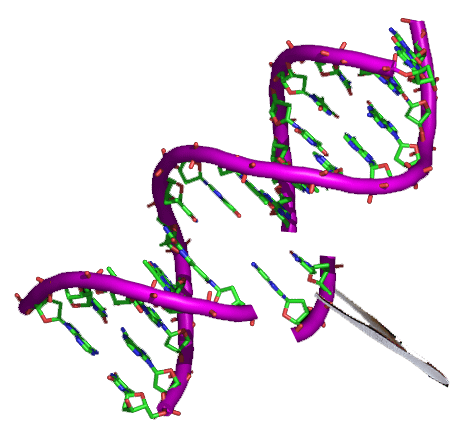
Image credits: Ciencias EspañolasKoS, CC BY-SA 3.0 https://creativecommons.org/licenses/by-sa/3.0, via Wikimedia Commons
Claims of wave genetics
This field of wave genetics simply says that our DNA follows rules just like language and grammar. While existing technologies are focusing on cutting and inserting DNA strands from one place to another, this technology promises to modulate cellular metabolism using radio and light frequencies, and thus repair genetic defects. Some capabilities of this technology include:
- Chromosomes damaged by X-rays can be repaired.
- Information patterns from one DNA can be captured and transmitted into another, thereby reprogramming the genome of an organism. For example, they claim to have transmitted salamander DNA onto frog embryos and successfully transformed those frog embryos into salamander embryos.
This work is claimed to have been achieved by a Russian biologist, Pjotr Garjajev, and his colleagues. The principle of transmitting this information from one DNA to another is based on the so-called Phantom DNA Effect.
Agreements vs. objections and disagreements to wave genetics
Not all biologists and scientists are satisfied with the claims of this field. After going over several scientific discussions and forums, I see that most of them disagree because these claims have not been peer-reviewed or replicated in multiple labs. Some of them feel that it is not adequate information to judge whether or not this research holds any value. Overall, the opinion seems to be divided between these two major viewpoints. I feel there is a discrepancy in their understanding of the wave structure of matter to relate to this research. But at the same time, not all is known about the wave structure of matter to push this experiment out of the window.
On the flip-side, I found some research whose results have been published in a peer-reviewed Nature journal and give an experimental basis to study the DNA phantom effect. Although the article focuses on the conceptual idea of controlling cancer using DNA’s natural resonant frequency, it does provide a convincing argument to study the wave phenomena related to genomic engineering. If you want to read more on this, click here, and you are welcome to respond in the comments if you have any explanations for all of us to understand.
Every discovery or invention that has changed history has always looked impossible at first, but further research has definitely helped science develop itself. For example, in the year 1900, Lord Kelvin said: “There is nothing new to be discovered in physics now. All that remains is more and more precise measurement.” during his address to the British Association for the Advancement of Science. But later in the same year, Max Planck gave his postulate about electromagnetic energy, which Einstein applied some years later to explain the photoelectric effect. And of course, some more years later Einstein came up with the Theory of Relativity, changing the course of physics forever. We must learn from such incidents and give a fair chance and time to every scientific claim to explain itself without ruling it out too quickly due to lack of evidence.
If anybody is willing to read and give this a real thought, you can start with this paper here on Linguistic Wave Genetics. And if you learn something worthwhile either proving or disproving this theory, I welcome all responses in the comments. After all, the main idea is to learn more about the workings of our own minds and bodies!
Using viruses to treat our genes?
Wave genetics is still pretty far from proving or disproving itself. While it is left to see if that field holds any mettle, we have a new technology that is definitely making waves. The idea of using engineered virus-like particles or eVLPs to deliver CRISPR and other base editing components to various organs is being tested out by a team at Harvard led by Dr. David Liu. Don’t worry. They are not real viruses. They are engineered particles made to look like a virus. As neuroscientist turned writer Shelly Xuelai Fan puts it in her article here, it is like a spaceship carrying gene-editing tools to its destination, with the only difference being the path taken depends on the design of the “spaceship” because once it is inside the body, we cannot guide or control it. Her article is a good explanation of this new concept, and if someone wants to read the paper published on this, they can do so here.

What did you think of this series? Let me know in the comments! We have so much information stored in us. How much of it do we actually put to use? Point to ponder?
Stay inspired! Stay mystified! Stay Priya-fied!
Discover more from Priyafied
Subscribe to get the latest posts sent to your email.

 Priyafied
Samajh ne wale samajh gaye jho na samjhe…. Tum kya karsakthe ho.
LikeLiked by 1 person
Very true 😅
LikeLike