
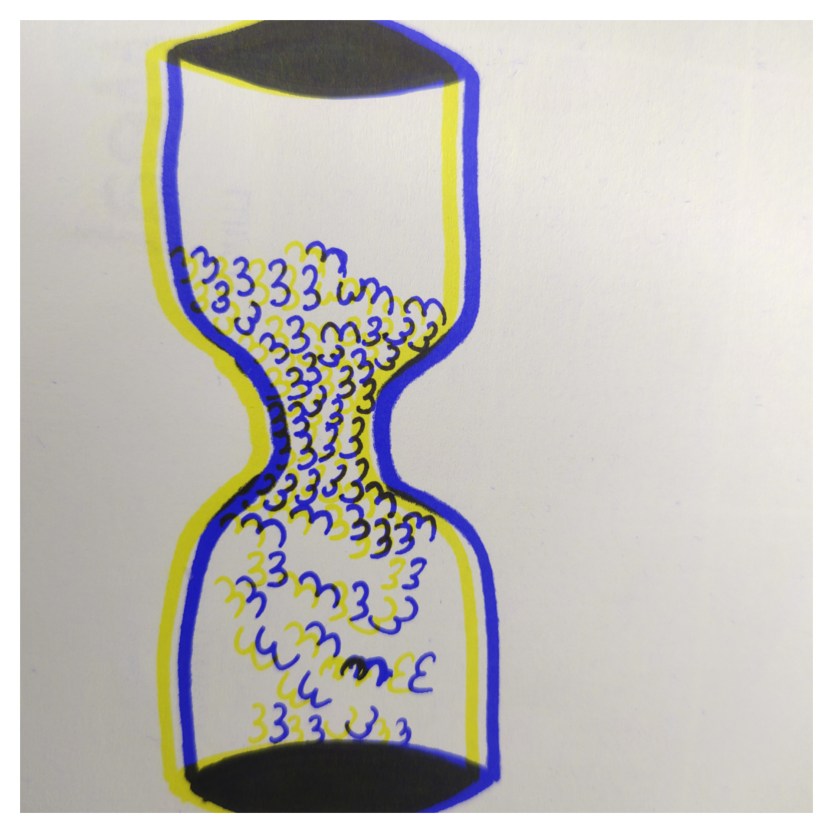
In my previous articles in the Time (Part I and Part II) series, I have talked about how time can be perceived and a discussion on travelling through time. At the end of the previous article, I said that exploration of the concept of wormholes appears to be the only plausible solution to our problem yet. Although they are still a theoretical concept, we know that if we discover one or find one in reality, we have all the science we need as a base to explain it. I encourage you to go back and read the first two articles of this series to get a good background for these topics. Worm holes are one of the most strangest and most fascinating objects (if we may say so) out there. I am not talking about black holes here. For the benefit of my readers, I will first try to explain them in very simple terms. Black holes have been studied and explored extensively for over hundred years now in modern science, starting with Einstein’s prediction of it in 1916 with his General Theory of Relativity. A lot has been said, written and explained about black holes already and I would refrain from repeating all of it again. But to put it in simple words, black holes are extremely dense regions in space that have so much gravitational power that even light cannot escape it. Hence the term “black” holes.
On the other hand, worm holes are simply two different connected points in space-time, like a tunnel that transports you to a different point in time and place than where you entered from. Simply put, if you entered a worm hole from your bed today, you may emerge some minutes later from another continent i.e. covering a distance in a much shorter time, or you emerge from the same bed after 100 years in a matter of minutes, i.e. transcending barriers of time and space. While science says that it is theoretically possible, no observational evidence has been found in common knowledge. However, today I attempt to view them through a different source from which the world today knows them.
I would recommend watching the following video from my previous article, where I explain worm holes for better understanding if you want to brush up your basics and you haven’t seen it yet.
Before I start, it is imperative to explain that it is futile to use current science to explain concepts in our ancient scriptures, for example. Sure it works for several things but there are also several things that current science has not been able to touch and things that are beyond comprehension of current science, simply because not all science is experimental or theoretical. There is also experiential science. This is not related to the concept of experiential learning. The concept of experiential learning these days implies teaching say, theories of science, to students through a series of applications that they experience for real. But the experiential science that I am talking about here, is cognitive and non-physical experience helping to develop and explain dimensions of phenomena and knowledge that is quite impossible to comprehend for a common man. So my article is an attempt to look at the concept of wormholes from the perspective of our ancestry and see if we reach a plausible new outlook to our problems with time travel.
Instances of wormhole travel
While wormholes have been calculated theoretically, we have not seen or experienced one yet. So a wormhole could lead you to your school or office from your bedroom, or to a distant galaxy altogether. We haven’t seen one form but it is possible in theory. So what exactly happens? Space-time can be visualized as a sheet of fabric on which our universe exists. While a sheet itself is two dimensional and we can move front, back, left and right, but space is three dimensional. So we can also move up and down. Scientifically speaking, time is the fourth dimension. It is difficult to visualize, but it is a factor that determines your existence. So to reach your office, you have to travel say, 2 kilometers across in 20 minutes. But by some means we fold the sheet so the two end points come close together. Now you travel the same distance in a shorter time, and you have warped the space and time fabric. You have travelled through a wormhole.
You could travel through the wormhole to reach the same point or a different point, but 100 years later. However, you took 2 minutes of your own time, while everybody aged 100 more years. This phenomenon finds a mention in the Kishkindha Kaanda (which is the fourth section) of the Ramayana. The premise is that Hanuman, along with his forces of the apes (Vanar sena), are sent by Sugriva to the southern side of the Kingdom of Kishkindha and look for Sita. During their search, they come across a cave or a cavity in the Vindhya mountains, called Riksha. The cave looked amazingly beautiful and seemed to have food, which the hungry travelers desperately needed. Importantly, as soon as they entered the cave, they seemed to lose orientation of the world they were in. After being fed by the protector of the cave, Swayamprabha, they ask her for a way out of the cave as they have lost the sense of time and space and cannot comprehend the method of exit. She asks them to close their eyes and makes them exit the cave within a minute. They emerge at the coast of an ocean in the far south. As they emerge out of the cave, they regain their sense of existence on the Earth and realize that a month has passed on the Earth, while they were only for a short while in the cave to eat. Mind you, these are words from the actual text. So while they aged a couple minutes, or at most hours, everyone on Earth aged a month. This suggests that they might have passed a wormhole.


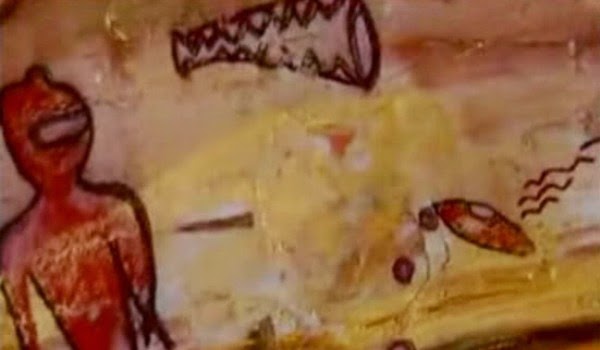
A similar mention can be found in the 3rd chapter of the 9th section of Srimad Bhagavatham. King Kakudmi, who was a descendent of the Suryavansha, traveled for some time to the Brahmaloka. But on his return to the Earth, 27 chaturyugas (27 cycles of all yugas) had passed here i.e. over 116 million years, while they spent only about 20 minutes! This also depicts the illustration of wormholes. So wormhole existed very well in that period as a practical concept, explainable by theory and experienced by cognitive advancement. I think the major problem that people face in believing these as actual events in history is the assumption that these people used their bodies, which are bound by physical constraints of the world. That is why cognitive advancement plays a much bigger role than theoretical or physical conceptualization. It should also be clear that all events, lessons, data and scientific concepts were written in the form of stories in prose or poetry in ancient times so that it is able to be grasped by the common man, and is not limited to those having studied science.


Now, the interesting part is knowing whether we can put these concepts into numbers. As we have already established before, time changes with respect to place and it is a matter of perspective. Such wormholes can be present anywhere in the universe, making it a network of complex portals. We know that time dilation makes time go at different speeds in different places in the universe. For example, Martian time goes faster than Earth time. But from the perspective of Mars, Earth time goes slower than Martian time. We are still talking about some fractions of a second difference. Keeping this in mind, if we go faster, we can increase this time dilation. Having said that, the major reason, according to Einstein’s general theory of relativity, for the time dilation between say Earth and Mars is difference in gravity. A higher mass leads to more gravity. This in turn, leads to a higher curvature in spacetime. So time is slowed down. But we will have to be close to at least half of the speed of light, or an insanely high or low gravitational pull to notice any humanly effects of significant quantity.
The mathematics
Let us delve into numbers now. I will take the case of Brahmaloka here. Hang on with me for a couple of minutes. I will simplify these numbers for you after this explanation. According to the units of time derived from the Surya Siddhanta, which in turn have been derived from the Atharva Veda, time is cyclic and not linear. There are four yugas in all that occur in cycles. Kali Yuga comprises 1 x 432k years, Dwapar Yuga comprises 2 x 432k years, Treta Yuga comprises 3 x 432k years and Satya Yuga comprises 4 x 432k years. In all, the entire cycle of all four yugas is 4320k years. If we put together 1000 such cycles, it forms half a day for Brahma. Hence one day for Brahma, known as a Kalpa, is about 8.64 billion years. So for every minute passed for Brahma, 6 million years would have passed on the Earth. This math has also been used to explain several other incidents and phenomenon in other books like Manusmriti, Vishnu Purana, Bhagavatham etc.
Going by these numbers, we are talking about a huge time dilation. This is most probably realized by having a place in the universe possessing a gravity or mass close to the event horizon of an entity like a black hole. If we look at this time dilation in detail, we arrive at a mass equal to 3000 trillion times our Sun! All the science enthusiasts, if you are interested to know, I reached these numbers using the Schwarzschild metrics, which is a solution to Einstein’s field equations. This kind of mass could be anything in the universe from stars to black holes to clusters etc. Stars aren’t very likely to be the answer as due to the Eddington limit, they have an upper limit to the mass they can be. Most likely explanations could be black holes. But the largest supermassive black hole we know yet is just 66 billion times the mass of our Sun (TON 618). We may discover larger black holes in the future as the scientists hypothesize the presence of ‘stupendously large black holes’ or SLABs.
That was some real math! For people who had difficulty with reading these numbers, here is a simple explanation to it. The takeaway from the math is that if you traveled to the Brahmaloka, 6 million years would have gone past on the Earth while you were in Brahmaloka for only a minute. And while you were there, the mass of the place you were standing on would be over 3000 trillion times that of our Sun!
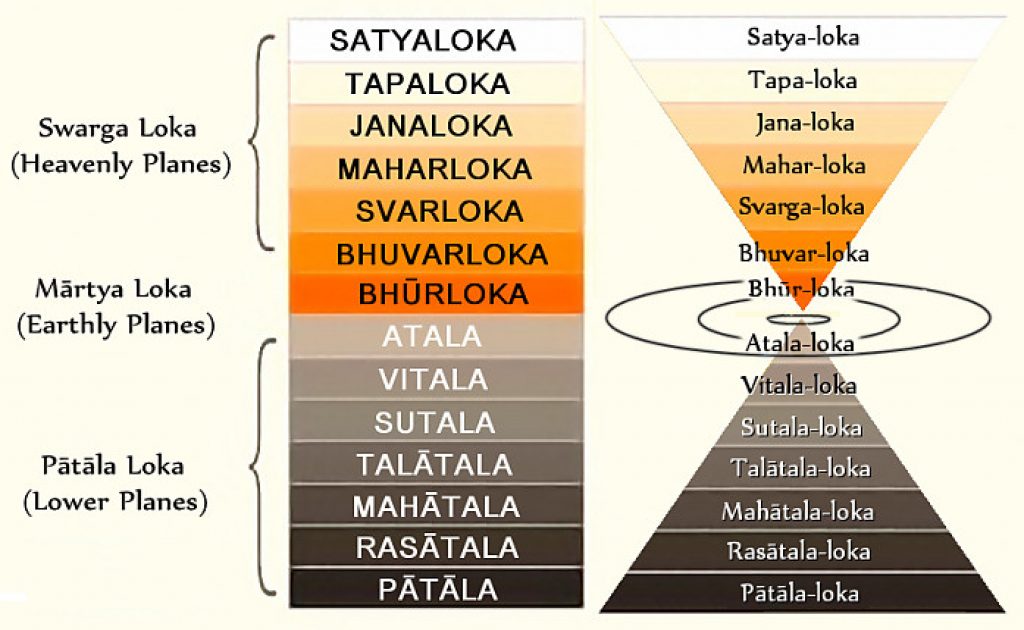
In addition, there are different planes of existence where the time dilation is different with respect to the Earth. In a similar manner as above, time dilation has been defined for Pitri (forefathers), Deva (Gods), Manu (progenitors) etc. Without going into more complex calculations, the crux of the matter is that existence on such different planes of time is explained as different planes of existence within the Brahmandam (Brahma + Andam i.e. the cosmic egg) depicted in a very simplified way in the image below.
While I do not claim to be a hundred percent accurate with these numbers, it is a very good estimation of the concept I aim to explain. Hence, the calculations needed to work out the usage of wormholes is already present with us. All that we need are minds sharp enough to harvest this knowledge. Yet Indians continue to undermine this treasure trove as mythology and pseudoscience. Maybe it is time to revaluate our choices of what we idolize. Point to ponder?
Be mystified! Be inspired! Be Priyafied!
Do let me know if you enjoyed this series, and I will continue to bring you articles on interesting topics like this! Get Priyafied!
Discover more from Priyafied
Subscribe to get the latest posts sent to your email.

 Priyafied
Your way of writing connects all dots smoothly and brings out what you intend to tell clearly. Great Work Priya 🤩👍
LikeLike
Thank you Anjali 🥰☺️
LikeLike
Excellent well articulated,no doubt you have satisfied, detoxified, mesmerised, your followers👣. Keep up the excellent work going👍.
On Fri, 2 Apr, 2021, 7:48 pm Get satisfied, Get detoxified, Get mystified, Get Priya-fied…., wrote:
> R Priya posted: ” In my previous articles in the Time (Part I and Part II) > series, I have talked about how time can be perceived and a discussion on > travelling through time. At the end of the previous article, I said that > exploration of the concept of wormholes appears to” >
LikeLike
Thank you Appa! 🥰
LikeLike