

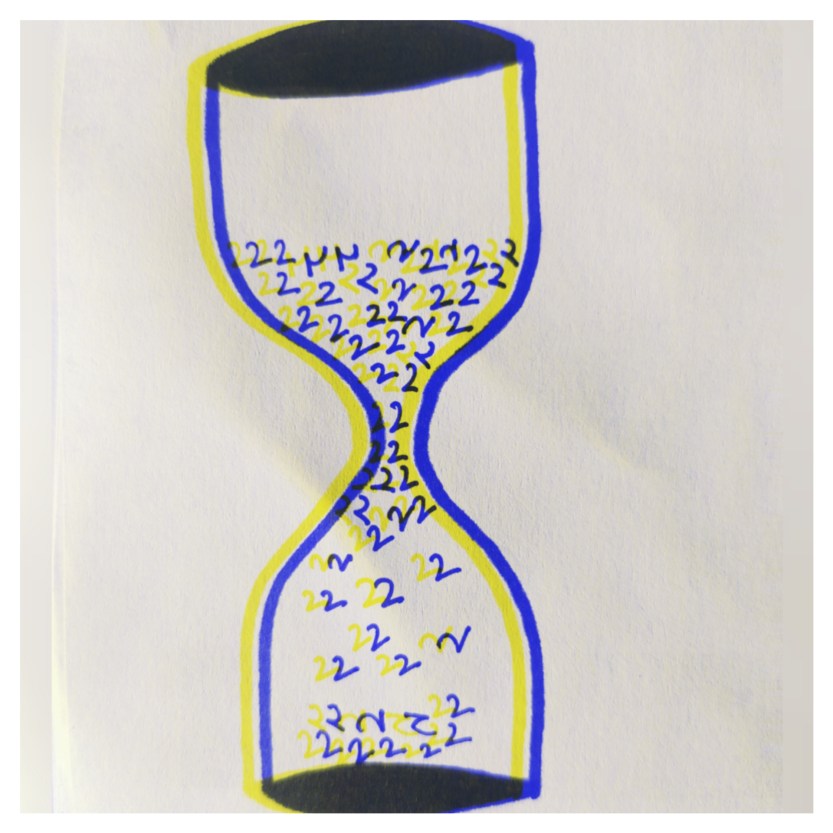
Time travel is a topic that will never stop generating excitement. What if I told you that time travel is practically achievable, and that there are people who time travel on a regular basis? Time travel is definitely possible theoretically, and practically is being achieved continuously. I am talking about astronauts. As they live in the International Space Station (ISS) for extended periods of time, they age slower than us living on the Earth, even if it is for a few milliseconds. This is because of something called time dilation. So if sometime in the future such a technology is achieved to be able to send humans to explore habitable exoplanets, they would have aged only two years when they returned while we would have aged over eighty years. Now that’s the interesting concept that deepens our curiosity into achieving time travel of considerable measure.
From my previous article here, we have understood time as a concept. We said that time is a perception that enables us to place events of our timeline in an order, and that speed does not hold significance in absolute reality. I encourage you to read the previous article if you haven’t already. I would now like to take our knowledge a notch further by asking a question that whether we can move from one frame of reference to another where the time is different. If at any point in the article, you get confused with concepts, bear with me and watch the video in this article, because science is not just for the scientists!
I will state a fact before going on with the article that we all travel in time at the rate of one second per second everyday for our entire life on the Earth. The curiosity in the concept of time travel is whether we can travel at a different rate, say 80 seconds per second i.e. future, or -80 seconds per second i.e. past.
Let us now make things interesting. Just like we move in space – left, right, up, down, front and back – what if we could move back and forth in time? Space has three dimensions and according to Einstein, time is the fourth dimension. So if we are able to navigate space effectively, we should be able to navigate through time as well. It would mean that we can travel into our future, as well as travel back to our past and maybe change events. Well that would create time paradoxes of possibly different kinds. A paradox is a logical contradiction associated with an idea. So if we were to travel into our past, there could be some very logical problems we might face. Consider a scenario. A 25 year old man named John hops on a time machine and travels back 80 years in time and prepares to land. Accidentally he lands on top of his grandfather, who was cycling on the road at that time and kills him. That would mean his grandparents never got married, which means his father was never born. And by extension John was never born either. Then John wouldn’t exist at all, which means no one went back in time. So John’s grandfather is alive in his time and got married, to lead to the birth of John’s father. And eventually John is born who hops on the time machine to go back in time and accidentally lands on his grandfather… This loop goes on forever, creating a paradox named as grandfather paradox. Of course it is possible that he landed on another place instead of his grandfather’s head during one of the times in the loop. But it is equally possible that he landed on his grandfather to make the loop go on forever. If this was not immediately clear, bear with me. Things will be clear in a moment.

Before that, let me confuse you more. Another scenario is possible that you go back into time and explain to Newton about gravity even before he made an observation related to it. Based on your information to Newton, he publishes the results and gets all the laurels and recognition. But it implies that you were a source of his learning, whereas you yourself learnt it because Newton made an observation. You have created a paradox called the Bootstrap Paradox, where the origin of the idea is unknown and the events are in a loop. In fact, these and similar other time paradoxes put events in a causal loop where the future event is the result of a past event, and due to the time machine, the past event is the result of a future event. Subsequently, the future event is the result of this new past event and the loop goes on forever. Such paradoxes are the major reason scientists believe that time travel to the past is not possible.
Let us change our minds and decide to travel into the future. Like I said earlier, astronauts who spend time in space are already time travelers by principle, even if it is for a few milliseconds. But we want more thrill. We want to travel to 2061 and see our future. Is it possible? Theoretically, yes. In fact one of the pathways leads us to the concept of wormholes. If we were to move in time like we move in space, we would have to warp time. Warping time means we fall through a tunnel that leads to another point in space and time, while we have taken a different amount of time to make the crossover. For example, if I want to travel to 2061, like I said before, to see how Paris looks like at that time, I curved spacetime and created a tunnel between now and that point. Then I went through that tunnel and reached Paris in 2061 within two years. It means that while I aged only two years, everyone else would have aged 40 years. Now that’s a problem. I might not be able to travel back in time now. Well, that’s a problem for another day because wormholes, while theoretically possible, are not a practical reality yet because scientists haven’t discovered or observed a wormhole yet. Moreover, wormholes are not stable even if they exist and collapse quickly, and are microscopic in size.
Take a look at the video below for a concise view of the article and easy explanation for these tough concepts, because the benefit of science is not just for the scientists.
Credits for the amazing animations in the video to a very talented friend, Astitva Pandey!
Then, what is another way we can travel into the future? It is basic physics that speed is equal to distance divided by time. This means speed is determined by how much distance you cover in a given time. If you cover 5 km in an hour, then you are fast. However, if you cover just 1 km in an hour, you are slow. It is as simple as that. This means time is basically how much distance you cover with a particular speed. So if we want to make time taken to travel to be very small, we would have to make our speed of travel very large. So if we travel at the speed of light, or even 99% of the speed of light, we might be able to time travel. Firstly, we do not have the technology to travel even close to the speed of light yet. But even if there comes such a technology, accelerating to this speed would induce so much centrifugal force that it could essentially rip you apart! So this method of time travel looks impossible at the moment.
Although, some new research has been published very recently this month regarding faster than light travel and spacetime warp. In 1994, Miguel Alcubierre proposed the Alcubierre Drive which, in simple terms, suggests that if you were to move inside a Alcubierre Drive, you would create a wave in the spacetime by expanding the space behind you and contracting the space in front of you. It essentially means you could ride this wave (like surfing) and travel faster than light. But doing this would again require tremendous amount of energy, probably even more than which is harvestable within our universe. His solution was negative energy which is neither defined nor harvested yet. However, this month two independent research works were published by Dr Eric Lentz from Göttingen University, and the other by Gianni Martire and Alexey Bobrick from the Advanced Propulsion Laboratory, Applied Physics, New York. Lentz attempts to build up on the work on Alcubierre and says that optimizing the shape of the bubble (in a soliton configuration) would make such a warpdrive possible. He derived Einstein’s equation for different shapes until he arrived to the form which would require the energy achievable by our current conventional energy sources. He even said that “This work has moved the problem of faster-than-light travel one step away from theoretical research in fundamental physics and closer to engineering”. However, we still need to figure out on how to generate energy equivalent to at least 30 times the current capacity of our nuclear reactors! Simultaneously, Bobrick and Martire suggest that instead of using negative energy, a massive gravitational force could be used to bend spacetime. Either way, realizing an actual time warp to travel faster than light is still in the far future it seems.
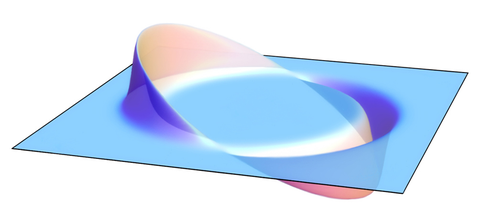
So we have wormholes as the only plausible method of time travel to be explored. What if we could curve spacetime in a way that it opens at the same space but in a different time? That might enable us to travel in the past as well. It could also answer some questions on solving the time paradoxes we face as obstacles. Even if we discover wormholes, it is impossible stabilize them yet. It is theoretically proposed that exotic matter i.e. matter having negative mass, can stabilize wormholes. But unfortunately, as I said earlier, exotic mass is neither defined nor harvested yet to proceed with the validation of this theory. But we sure look at our future expectantly.
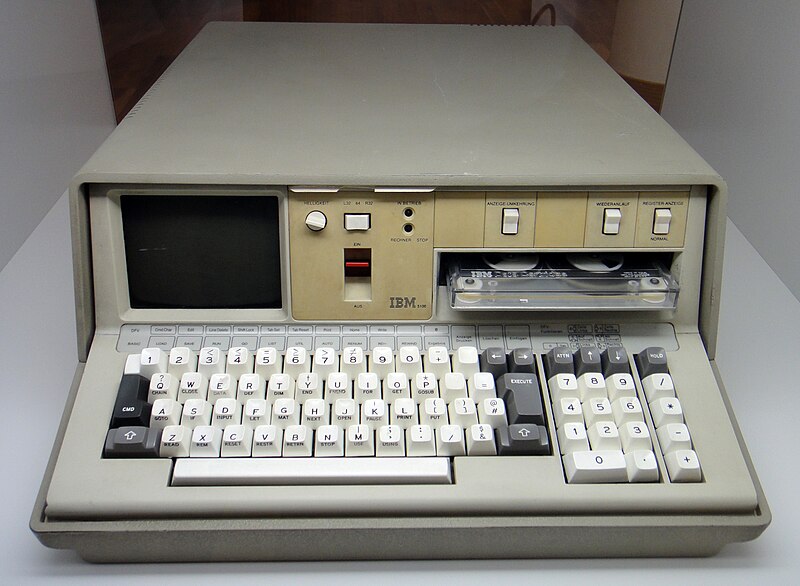
Over so many years, there have been instances of time travelers coming out to the world to tell their stories. While most of these appear to be hoax, there have been some really famous and intriguing cases. In one of my previous articles here, I talk about some famous cases of supposed time travel over so many years. Although all of them appear to be hoax or hallucinations of people involved, one prominent case stands out to be considered. In November 2002, a message appeared on the Time Travel Institute Forum, an internet discussion forum, from a man called John Titor. He called himself “Time_Traveler_0” and said that he is going back to 2036 after obtaining the IBM 5100 from 1975. He had stopped over at 2000 for “personal reasons”. Thereafter he made over 570 posts online until March 2001 before signing off and supposedly going back to 2036. It might have been hoax like any other time traveler story, but the reason it garnered so much attention is because he had described his time machine in details along with a diagram. He had described it as a “stationary mass, temporal displacement unit powered by two top-spin, dual positive singularities”, producing a “standard off-set Tipler sinusoid”. He even put up schematic diagrams to illustrate his “time machine”. It certainly baffled and intrigued investigators since it showed real science, but isn’t plausible for real. John Titor disappeared as suddenly as he had come. Interestingly, he mentions that there are infinite number of worldlines (or timelines), and hence, paradoxes are automatically taken care of as a result. There isn’t much information on this man on the internet though apart from his posts and communications. The world is divided on whether he was a real time traveler, or a conspiracy of some sort, or a complete hoax. I guess we will know for sure in 2036, unless we have spiraled into a timeline different from where he had visited us!
Unfortunately today’s technology is not developed enough to enlarge or stabilize wormholes even if it is discovered or observed. But who knows what the future holds. We may have paradox-free, wormhole based mode of transport in the future, which will enable us to travel through space as well time. Stephen Hawking said once that “The best evidence we have that time travel is not possible, and never will be, is that we have not been invaded by hordes of tourists from the future“. But we can never be sure that among the people you see around you, some of them may be time travelers in disguise. While we persevere, our ancestors or descendants may be shaking their head in disbelief as we continue to believe that time travel is practically not possible just because we do not have a complete framework of analysis or understanding of it.
Point to ponder? Stay inspired! Stay mystified! Stay Priyafied!
Await my next article in this series where I am attempting to look at wormholes in a whole new light and rediscover them from a different perspective. Maybe the answer was already there in front of us and we aren’t seeing it. Let’s see if we can solve the puzzle!
Discover more from Priyafied
Subscribe to get the latest posts sent to your email.

 Priyafied
Can u plz explain…what do u mean by negative energy???
LikeLike
Negative energy is a slightly complicated term that we do not have a complete framework of yet. But to put it in simple words, it’s like an empty bank account that can still be overdrawn, but money must be returned later. So negative energy is when the energy level goes below zero and involves quantum physics. And normally this is used in the physics of time travel, wormholes, warp drives, etc. It has not been defined perfectly yet, so there is still a lot of illusion to it. I would recommend you to read this article for some information on this if you are interested (https://www.sciencedaily.com/releases/2019/10/191002102750.htm).
And thank you for following my blog 😊
LikeLiked by 1 person
I have read this article but I’m not getting it exactly but will try😅
LikeLike
Okay no problems. I will try another explanation. When two bodies in space are infinitely apart, then the energy between them is zero. But when they start moving towards each other, their kinetic energy increases. But since they are closer, their gravitational energy also increases. However, we cannot break the law of conservation of energy. So to balance the increasing kinetic energy, the gravitational energy must be negative. Because if it isn’t then the universe would end in big crunch. But with negative energy it will expand. It’s not a straightforward thing but certain conditions must be met. That’s why I said that it’s not completely worked out yet. This video might help: https://youtu.be/M2d_zzMcEGs
LikeLike
How beautifully you write girl! I can’t take my eyes off until I finish reading it in one go.
The topics you write about bring out the scientist hidden in me 😂
Beautiful piece of writing, keep up the great work!
LikeLike
Thank you Anjali 🙂 That’s my motive so that everyone connects with science in a healthy way. I’m glad it’s working☺️
LikeLike
“Neththi adhi”means heavy punch👊,Well articulated, still wonder how many will understand😉, keep the good work going 👍.
On Sun, 21 Mar, 2021, 8:58 pm Get satisfied, Get detoxified, Get mystified, Get Priya-fied…., wrote:
> R Priya posted: ” Time travel is a topic that will never stop generating > excitement. What if I told you that time travel is practically achievable, > and that there are people who time travel on a regular basis? Time travel > is definitely possible theoretically, and practica” >
LikeLiked by 1 person
Thank you Appa ☺️😅
LikeLike