

I have written much about astrology and astronomy, where I drew parallels on astrology and astronomy, insights into the basis of astrology, and most importantly, the mathematical reason why Vedic astrology works in my previous articles in this series (Part I, Part II, Part III). While astronomy became science’s favorite, astrology turned out to be the shunned child. I already gave an account of the mathematical and logical basis of Vedic astrology. When you type Astrology in Google search, the Wikipedia page for Astrology is one of few major hits. The first few words itself have declared it to be pseudoscience and when you go further, you will read the statement “While polls have demonstrated that approximately one quarter of American, British, and Canadian people say they continue to believe that star- and planet-positions affect their lives, astrology is now recognized as a pseudoscience — a belief which its advocates incorrectly present as scientific.” Such statements are very common all over the internet as well as in the viewpoints of people who favor “science”.
This statement as well as similar statements have been supported by scientific papers and research work done on the validity of Astrology. I went through each of them, as well as several other tests performed on Astrology through history. Here, I list out the major scientific validation tests done on Astrology till date in a concise and understandable manner.
- Before 1983, there were a few tests conducted to validate astrology. However, it suffered from less sample size, biased testing methods and alleged unfair treatments. Hence, the further scientific publications have disregarded those tests as inaccurate.
- In 1983, a double-blind test of Astrology was conducted and published by the Lawrence Berkeley Laboratory, University of California. For those unaware, double-blind tests mean that neither the researchers nor the subjects know the identity of researchers or subjects personally in order to eliminate bias. The test was done on Natal Astrology alone, based on concepts of Tropical Astrology. It relates to the interpretation based on the birth chart alone. This was a two part test – volunteers choosing what they thought was their natal chart interpretation from the entire set of predictions of all volunteers, and, astrologers choosing what they thought was the closest CPI result to the natal chart data given to them. The result that they have given is that “Great pains were taken to insure that the experiment was unbiased and to make sure that astrology was given every reasonable chance to succeed. It failed.“.
- In 1990, another test was conducted at the Indiana University by John H. McGrew and Richard M. McFall. It conducted the test with the help of six astrologers from the Indiana Federation of Astrologers (which doesn’t exist anymore). As per their scientific paper, the test was conducted by giving astrologers as much information as they needed about the volunteers, so that they are able to match the Natal chart given to them to the right person profile. The result they have given is that “The results were clear-cut. Six expert astrologers failed to do significantly better than chance or than a non-astrologer control subject at matching birth information to the corresponding case materials for 23 individuals.“.
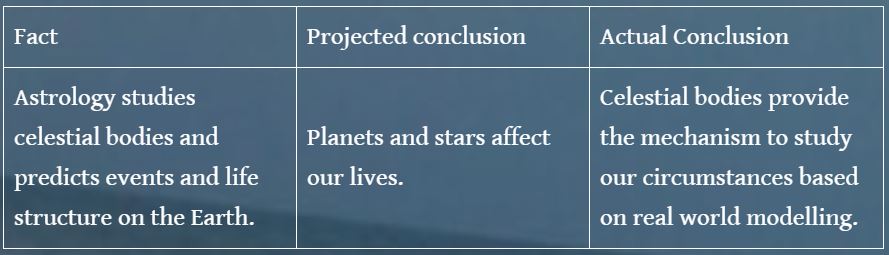
- Apart from all these statistical tests, scientists and astronomers are fixated on finding the physical, chemical or biological phenomena that relates celestial bodies to human personality (For example, Richard A. Crowe 1990, James R. Barth et al 1974. In fact, there have been over a hundred such publications). And when they could not find any, astrology was simply declared as pseudoscience, without considering the fact that to validate an entire study, the dedicated study of the science itself is necessary first. Anyway, this point is null and void as the basis of this argument itself is flawed. Refer to the table below which explains how astrology is projected into the wrong conclusion.
Before I go any further with discussing the interpretation of these tests, it is important to note why this debate of astrology being pseudoscience started. Astrology of any method was used and believed since its inception. But during the eighteenth century, it started losing popularity in the West over concerns that the Astrology based on Ptolemy’s work is not progressive in nature. However, it did start gaining popularity post 1930s. Subsequently in 1975 in America, astronomer Bart Bok, writer Lawrence Jerome and Professor Paul Kurtz formulated a group condemnation of Astrology, which was signed by 192 leading scientists, which included 19 Nobel Laureates. However, the attack on astrology was based on the following three statements: –
- Astrology originated as part of a magical world view
- The planets are too distant for there to be any physical foundation for astrology
- People believe it merely out of longing for comfort
I am not going into details of their analysis here, but their results themselves are not a criteria enough to declare Astrology to be pseudoscience. Consider the following lines from the work: –
“He analyzes the axioms of astrology and shows that they are based on the magical principle of correspondences, and that therefore they cannot be considered valid in the eyes of modern science.”
“He concludes his article with a reminder of the efforts that have been made to validate astrological predictions using statistical methods.“
First – every scientific theory is always a hypothesis at its origin, second – psychological reasons for people believing or not believing something has got nothing to do with scientific evidence and third – many scientific theories have been proposed till date which had no physical foundation to them but later proved right, including continental drift, when a suitable method of testing was devised. Importantly, nobody is an authority in science, because a theory working well for the present times could be successfully challenged by future scientists. Keeping this in mind, it is insufficient to refute the claims of Astrology based on biased opinions and studies. After this report, several tests were conducted, some of which I have listed above, to validate astrology. This chain of events occurred despite Indian astronomers pointing out the mistake in evaluating Indian astronomy by “modern” western astronomers, which I have talked about elaborately in Part III of this series. Do go back to read it if you haven’t already.
Ironically, Galileo Galilei and Johannes Kepler, the scientists whose works in science are used in attempts to invalidate astrology, were professional astrologer themselves!
Coming back to the test results, I am sure that you would have noticed a pattern in all the validation tests as well as scientific papers – (i) Only one form of astrology has been tested i.e. Tropical Astrology, (ii) only Natal charts are scrutinized for correctness, (iii) only a particular community of Astrologers have been selected for testing, and (iv) the modus operandi of all tests is purely statistical in nature. While the western countries have been extremely selective in their analysis, they have been very vocal and loud in condemning all other forms and methods of astrology as well without any solid basis. The massive wave of westernization has contributed negatively to this trend and has resulted in people of all cultures be disbelieving of their own culture. And this is not good. Here, I will insert an example of a relatively recent study published in 2009, where the author, Manoj Kamath, elaborates in detail of the scientific studies performed through decades on Western Astrology, and concludes that just because the extensive studies on western astrology failed to prove it, conducting such tests on Indian Astrology is a waste of resources. I strongly condemn such statements as no decision can be imposed on any field of study without any conclusive tests.
I will take the case of Vedic Astrology further here. Vedic astrology considers the birth chart/Natal chart as one of the most important charts of course. But there are more than 20 other basic charts used for predictive astrology, that are case studies of every combination of planets, stars, positions, degrees and relationship. Also, the method of drawing the birth chart is also very different in every case. In addition to the number of charts studied, there are several more concepts that are taken into consideration before prediction is given – the individual’s environment (Rashi, Ascendent, Nakshatra, Houses, Dasha, Bhukti, Transit etc), the individual’s response (Planets, indicators, relationships, strength etc), hundreds of yogas, and much much more. In addition, while the basis of sidereal astrology remains intact, the methods of deriving predictive astrology is different for different regions and ideologies within India. In short, to give you an estimate, the birth chart is not even 5% of the whole picture, and even provides the working mechanism to study birth twins and the debatable case of time twins.
I am not the first person to raise the issue here. There have been many astrologers (like B.V. Raman), and several believers who have spent their lives in getting Vedic astrology its due in science with the help of mathematics and logic, and there will be many more in future. I am no authority in either Astronomy or Astrology. But I know and understand enough to realize the value of this science. And I also simultaneously wonder, if people will stop being hypocrites and embrace knowledge as it is without bias.
In short, it is very unfair to condemn the entire astrological science on the basis of a few statistical tests conducted in an extremely selective community on a single form of Astrology. What do you think? Point to ponder?
Be mystified! Be detoxified! Be inspired! Be Priya-fied!
I hope you have enjoyed and learnt from this series on Astrology and Astronomy. Stay tuned with me for mind boggling topics that will force you to think, because that’s what we all are here for!
Discover more from Priyafied
Subscribe to get the latest posts sent to your email.

 Priyafied